
Suckers Bet, Winners Invest
In the 1980s, near the Tropicana Casino in Atlantic City, there was a pizza joint where I first got introduced to casino games. I would sit in a booth, savoring a greasy slice, while my uncle shared stories about blackjack strategies and craps probabilities.
My uncle never went to college but attended dealer school instead. I remember watching him in my grandmother’s kitchen practicing shuffling with multiple decks of cards. He always had oversized red dice or decks with drilled holes in them.
After those late-night lessons, I realized gambling is a form of entertainment — it costs money to play, and even winnings rarely cover the losses.
I still enjoy sitting at a table now and then for fun, but I would never view it as a legitimate plan for retirement.
Yet today, an entire generation seems to be doing just that. A poll from St. Bonaventure University reveals that 27% of Americans, and 52% of men aged 18 to 49, maintain sports book accounts.
Among those surveyed, 85% believe they can make a profit from betting. However, only about 4% actually succeed in the long term. Research from UC San Diego’s Rady School of Management found that 96% of bettors lose money. The lead researcher noted:
“Only 4% made money from online betting. That is by design. Online gambling platforms often ban or throttle frequent winners’ accounts. There is no right to gamble.”
That’s quite a lucrative model. Ads for gambling apps saturate the media landscape. Whether it’s TV sports, podcasts, YouTube, or popups, it’s nearly impossible to escape promotions for DraftKings, Hard Rock Bets, Fan Duel, and now Kalshi, which allows betting on virtually anything.
Gambling is far too accessible nowadays—and intentionally so. Remember the old saying: if you don’t know who the “fish” is at the table, it’s you. The fish represents the inexperienced player who always loses. On these betting apps, you are always that fish.
There’s a reason these apps are so easy to download—they want your personal data. Like countless other online subscriptions, signing up turns you into the product.
Some apps even offer sign-up bonuses to lure you in. I saw an ad recently promising $100 in bets if you deposit $10. If you think that’s a generous gift, well, as we say down south, “Bless your heart.”
These platforms rake in so much revenue they can afford to take a small initial loss just to get you hooked, knowing they’ll recoup much more over time. They make a profit from every wager, often referred to as the hold or the vig.
For large, liquid bets on football or basketball, the vig ranges around 4% to 5%. For player prop bets, it rises into double digits, and futures markets can carry vigs from 15% up to 30%.
That’s why betting apps should never be mistaken for investment vehicles.
By comparison, professional fund managers charge fees between 0.01% and 1.5%, with most hovering under 0.75%. A 1% fee requires clear active management or strong justification.
Anything higher than 1% management fee is considered costly.
In contrast, bets cost you much more. For example, bets at -110 odds carry at least a 5% cost thanks to the vig. Here’s the math…
If you place 100 bets of $110 each at -110 odds and win half, you are still down $500 due to the vig. To merely break even, you must win about 53 out of those 100 bets. And that’s just the basic wagers. According to Fox Sports, here are the typical vig percentages charged by betting apps:
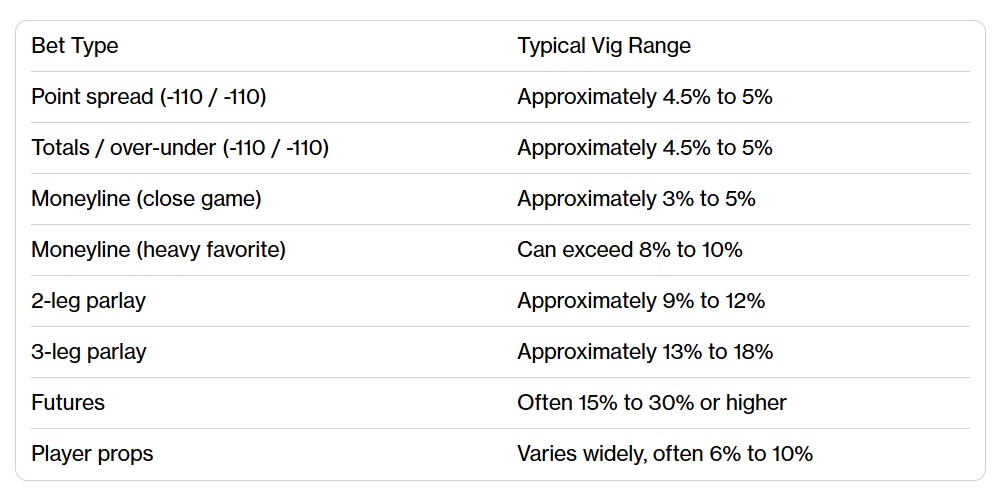
It’s important to understand how unrealistic it is to “invest” through gambling apps. These activities are purely for entertainment and speculation, not investment.
For example, imagine placing $100,000 into an investment fund earning 7% annually over 30 years. With a minimal fee of 0.1%, your effective yield would be 6.9%, growing your investment to $740,000. If the fee rises to 1%, your net return drops to 6%, making your total $574,000.
These calculations are what serious investors rely on. I’ve seen adults get frustrated over a 0.25% fee difference because it becomes significant over three decades. Paying 10% per bet and labeling it investing just doesn’t make sense.
Online gambling is a booming industry expected to expand at 12% per year until 2033. Currently valued near $100 billion, forecasts by Polaris Market Research suggest it could reach $279 billion by 2034.
To put that into context, the global copper market is around $260 billion—meaning online gambling could surpass it within eight years.
A smarter strategy would be to channel most of your betting budget into stocks instead. One option is investing in funds like the Roundhill Sports Betting & iGaming ETF (NYSE: BETZ).
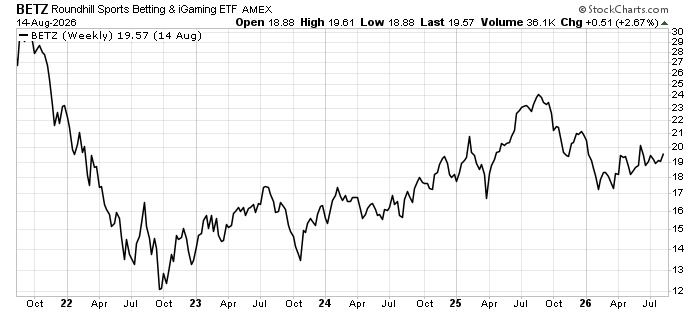
BETZ’s leading holdings include:
- Evolution AB: 7.2%
- Futter Entertainment: 7.1%
- DraftKings: 6.5%
- Allwyn AG: 6.5%
- Light & Wonder: 5.4%
- Lottomatica Group SpA: 5.2%
- Super Group: 5.1%
- Entain PLC: 5.0%
The management fee for BETZ is only 0.75%, which is a solid alternative. The odds here are certainly more favorable than those on these companies’ betting apps.
To be clear, I’m not trying to discourage anyone from gambling. If you enjoy it, go ahead.
My grandfather played the numbers weekly for as long as I can remember. We’d gather on the couch as ping pong balls were drawn from the cages. He was always just one number shy. We laughed every time. It was pure amusement—not a strategy for retirement.
About the Author