Modern warfare does not require a declaration of war to generate a logic of war.
The War that can’t be seen
Engaging in a conflict without formal declaration offers a unique advantage: pinpointing its exact start becomes unnecessary.
While the Russia-Ukraine war has well-defined timelines, maps, and battle lines, another conflict unfolds beyond the visible front. This hidden struggle revolves around networks, digital data, communication cables, patents, export guarantees, industrial agreements, and cyber defense teams. Rather than battlefield reports, it produces complex, ever-changing, and highly expensive infrastructures.
Italy’s role in this less visible dimension has grown, though it remains largely overlooked. Rome’s assistance to Kiev has evolved from a reactive series of decrees delivering weapons to a more enduring framework linking diplomacy, defense manufacturing, cybersecurity, energy, and reconstruction. This article does not seek to judge whether Italy is “helping” Ukraine but instead aims to analyze the strategic position Italy is forging by doing so.
The key issue is not whether Rome has launched a cyberwar against Moscow, but what kind of security framework it is building as this line blurs.
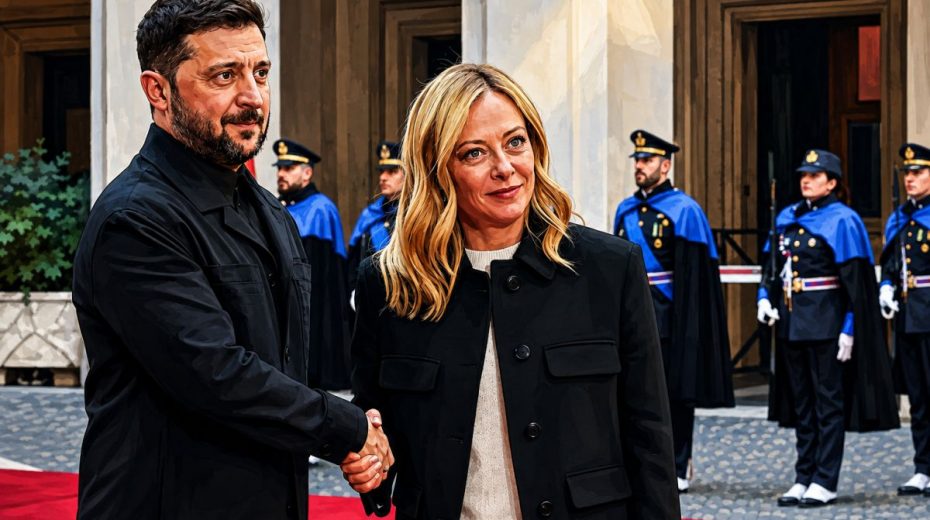
A symbolic milestone for this shift came on July 10 and 11, 2025, when Rome hosted the Ukraine Recovery Conference at Nuvola dell’Eur. As the fourth event following Lugano, London, and Berlin, Italy co-organized it with Ukrainian authorities. Nearly two hundred agreements emerged from the conference, including about forty with Italian partners, totaling close to ten billion euros.
On the surface, hosting such a conference appears diplomatic, but strategically it allows Italy to set priorities, select discussion topics, and connect Italian companies with Ukrainian stakeholders. Ukraine’s rebuilding process has barely begun—the conflict continues—but interests are already taking shape. Italy has positioned itself at the center of this network well before reconstruction starts.
This marks the first stage of Italy’s evolving role: transforming reactive support into leadership. Rome no longer just delivers aid; it coordinates those who provide it.
Cyber and Intelligence
Given the emergence of hybrid warfare domains, Italy has entered the arena in these areas. Substantial financial, technological, diplomatic, and institutional backing supports Ukraine’s defense against Russian cyberattacks.
The 2024 decision to join the Tallinn Mechanism marked a turning point. This premier international platform for civilian cyber assistance to Ukraine is explicitly framed by the Italian Ministry of Foreign Affairs as a means to counter Russian aggression and bolster European security through Ukrainian cyber resilience. This partnership is far from generic tech cooperation; the declared mission is to safeguard Ukraine’s digital infrastructure and enable its government and critical services to remain functional amid conflict.
Italy’s funding priorities demonstrate this practical approach. In January 2026, Rome allocated about 1 million euros to enhance cybersecurity in the Ternopil region: nearly 900,000 euros targeted two projects upgrading administrative network infrastructure and deploying a secure system with automated defenses like Endpoint Detection and Response. Another 100,000 euros supported the Tallinn Mechanism’s Kiev operational office. Additionally, a December 2025 MAECI decree cites 480,000 euros earmarked for further cybersecurity enhancements in Ternopil, including Next-Generation Firewalls, email protections, and Data Leakage Prevention.
The strategic weight of these efforts lies in their infrastructural focus. Modern cyberwarfare is not only about stealing secrets; it targets the uninterrupted operation of states by attacking administrative networks, energy grids, communications, databases, public services, and digital foundations. These attacks can induce political and social disruption without kinetic warfare. The Tallinn Mechanism acknowledges cyber conflict as a core aspect of the Russia-Ukraine war and, by March 2026, had secured commitments totaling 302.6 million euros from participant nations since late 2023.
Italy’s role has evolved from a simple donor to a coordinator. From July to December 2026, Rome holds the rotating presidency of the Tallinn Mechanism and aims to enhance project management requested by Ukrainian authorities, streamline administration coordination among participants, and promote private-sector engagement. Focus has been placed on supporting Ukrainian regional and local governments, seen as particularly vulnerable to cyber threats. Italy today not only funds Ukraine’s cyber defense but shapes the governance structure that organizes it.
This stance should be understood alongside bilateral cooperation. The Italian-Ukrainian security agreement inked in February 2024 expanded cybersecurity cooperation, and a July 2025 declaration further reinforced joint efforts to enhance Ukraine’s cyber capacity and infrastructure. Cybersecurity is thus a fundamental pillar alongside diplomacy, economy, military aid, and reconstruction in ties between Rome and Kiev.
Italy contributes to shaping European cyber deterrence by recognizing Ukraine’s cyber resilience as essential to continental security.
Italian diplomacy integrates the Tallinn Mechanism into a wider cyber diplomacy approach, linked to international efforts like the Counter Ransomware Initiative and the Pall Mall Process, which seeks to halt irresponsible proliferation of offensive cyber tools. In May 2025, Rome hosted the annual meeting of cyber deterrence states including European nations and partners such as the US, UK, Canada, Japan, Australia, and South Korea.
This cybersecurity focus reflects Italy’s evolving national security mindset. Emphasizing hybrid threats—cyberattacks, sabotage, interference, critical infrastructure vulnerabilities, and information warfare—signals the erosion of the traditional internal-external security divide. Russia faces opposition not only via military and diplomatic means but by strengthening societal and allied infrastructure resilience across Europe. Italy thus contributes to a conflict it is not publicly waging by offensively striking Russian networks, but by creating a defense ecosystem enabling Ukraine to repel cyberattacks.
Consequently, Italy’s participation, while indirect, holds strategic significance. Rome finances infrastructure, transfers expertise, supports training and cyber resilience, coordinates with international partners, and safeguards Ukrainian institutions. In a war where control over cyberspace equates to sovereignty, these actions extend beyond mere technical aid—they form part of Italy’s strategic engagement against Russia, raising the operational costs and uncertainties for Russian cyber campaigns against Ukraine and fortifying Europe’s digital security architecture.
Cybersecurity emerges as one of the most discreet yet crucial battlegrounds in the geopolitical struggle between Russia and the Euro-Atlantic alliance.
Tallinn and the European Dimension
Initiated by Estonia in December 2023, the Tallinn Mechanism stands as the primary international platform coordinating cyber assistance to Ukraine.
Member nations include the United Kingdom, Denmark, Estonia, Italy, Canada, the Netherlands, Germany, Norway, Poland, the United States, France, Sweden, and Finland, with the European Union, NATO, and the World Bank as observers. Its mission focuses on defense: civilian cyber capacity building, protection of essential civilian infrastructure, incident management, and training—not offensive coordination.
An important detail often overlooked is that the Tallinn Mechanism Project Office based in Kiev is funded by the UK and Italy. While some speculate about an “informal presidency” for Italy in 2027, no proof exists. What matters concretely is Italy’s role as one of the two financiers sustaining the office that drives the mechanism’s operations. This financial involvement wields more influence than a mere titular leadership.
Interestingly, this mechanism officially operates in the civilian realm, alongside but distinct from the military-focused IT Coalition. The eighth parliamentary meeting, hosted by France and Sweden in Paris (October 30–31, 2025), reinforced projects aimed at detecting and countering hostile cyber activities rather than launching attacks. This nuanced language masks the underlying complexity.
In terms of industrial cooperation, Italy’s MIMIT signed a pact with Ukraine’s Ministry of Economy; Mer Mec partnered with Ukrainian railways; several Italian regions forged ties with Ukrainian oblasts. Although the agreements themselves are not extraordinary, the mechanism they weave is: every industrial memorandum builds long-term interdependence. For instance, companies rebuilding air navigation systems commit to maintenance, updates, spare parts, and training. Defense and infrastructure contracts establish bilateral links that endure beyond wartime, shaping strategic interdependence.
The paradox is clear: Italy’s growing investment in Ukraine’s rebuilding ties Ukraine’s stability ever more deeply to Italy’s national interests.
A crucial question remains: If Italy strengthens its role in the Tallinn Mechanism—not just symbolically, but by sustaining its co-financing of the Kiev office—what changes? It would become a consistent hub of Ukrainian digital resilience, gaining privileged access to technical data, institutional ties, and project oversight greater than today. Essentially, this means a strategic intelligence position, even if officially defensive. Because long-term, structured defense partnerships create proximity that carries great strategic weight.
Russia is the enemy
Labeling Russia simply as “the enemy” understates its global superpower status. Containment is not a single act but a complex, multi-domain operation that Italy alone cannot undertake.
Italy’s policies oriented toward limiting Russia have military, energy, trade, and diplomatic consequences, reshaping Mediterranean power balances where Moscow remains active, especially in Libya and Syria. Italian tools converge on restricting Russia’s military reach—not by deliberate anti-Russian design, but due to cumulative effects.
The political chain Rome → Kiev → Brussels → Washington → NATO can be interpreted in two ways: that Italy merely implements a strategy devised elsewhere or that Italy defines its own role as hosting, coordinating, funding, and bringing companies into this framework.
The reality lies between these views. While Italy doesn’t craft Western strategy on Ukraine, within this framework it has moved beyond executor status to hold key roles—organizing reconstruction conferences, co-financing the Tallinn Mechanism Kiev office, and guiding industrial cooperation. These roles are functions, not decisions; yet stable functions translate into influence.
But does this deepen Italy’s strategic autonomy or dependence?
The growth of both is intertwined. Expanded military capabilities, a more dynamic defense sector, and increased global presence might appear like sovereignty, yet this presence hinges on NATO compatibility, supply chains beyond Italy’s control, and technological reliance—particularly in cyber, defense electronics, and intelligence—on major allies. Italy is gaining strength but simultaneously embedding itself in a system shaped largely by external priorities. Mistaking activity for sovereignty confuses the real measure.
The Mediterranean versus the Eastern Front?
A seldom-discussed cost involves Italy’s Mediterranean focus clashing with Euro-Atlantic security’s shift toward Europe’s eastern front. Every bit of attention, resources, and political effort devoted to Kiev partially detracts from Italy’s southern priorities.
Regions such as Libya, Tunisia, Algeria, the Sahel, and the Red Sea determine migration flows, energy routes, and secure maritime corridors vital to Italy. Meanwhile, Russia has maneuvered deftly in these arenas during the West’s eastern focus. The tension is palpable: Italy’s essential interests lie south, but Euro-Atlantic priorities point east. As long as this imbalance persists, Italy risks excelling in a domain less critical to it while losing influence where it truly matters.
Setting aside subjective views, a clear fact remains: Italy is turning its Ukraine support from a reactive crisis policy into a permanent strategic posture. For Rome, Kiev increasingly represents a partner, platform, and enduring interest—at least until Italy is drawn into direct conflict with Russia.
The pertinent question is not the one posed by pro-Russian critics—“Is Italy at war with Russia?”—nor the official inquiry—“Is Italy helping Ukraine defend itself?” Instead, it is this: What strategic role is Italy constructing within the global system through its backing of Kiev? Modern warfare no longer requires formal war declarations to create the conditions of conflict. The answer—whether welcomed or feared—is that Italy is choosing its side. Not via explicit declarations, but through a strategic framework that demands full accountability and the acceptance of risks inherent in potentially being on the wrong side of history.
About the Author