The Economic War Goes Nuclear
Treasury Secretary Scott Bessent has unveiled a strategy designed to tighten economic pressure on Iran.
Describing the effort as an “economic D-Day,” Secretary Bessent provided additional details during a press briefing held at 2:00pm ET.
Here is what Bessent shared on X yesterday:
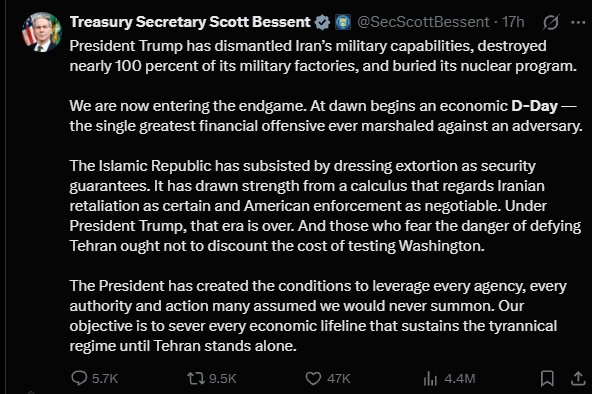
Source: Scott Bessent on X
The final sentence is particularly striking:
“The President has created the conditions to leverage every agency, every authority and action many assumed we would never summon. Our objective is to sever every economic lifeline that sustains the tyrannical regime until Tehran stands alone.”
Those are powerful words—especially the part about employing measures “many assumed we would never summon.”
By the time this newsletter reaches you, Bessent’s press conference will have concluded, and he will almost certainly announce stricter sanctions—perhaps with some unexpected elements.
The key question remains: will this strategy successfully impact the Iran-China-Russia alliance?
Brass Tacks
What exactly does this mean? It involves imposing sanctions not only on Iran but also on countries and entities conducting business with Iran—these are called secondary sanctions.
This primarily targets China, which purchases around 80% of Iranian crude oil. Various banks, shell companies, ports, and insurers linked to this trade may also come under scrutiny.
It’s important to recall that in May, the U.S. imposed new sanctions on five Chinese oil refineries that process Iranian crude. Previously, China usually complied with such sanctions even if quietly circumventing them.
This time, however, they openly refused to comply. Fox News reported:
China has ordered companies to disregard U.S. sanctions targeting Iranian oil, forcing a direct test of Washington’s ability to enforce its crackdown on Iran.
A new directive, issued through China’s Commerce Ministry Sunday, invokes a 2021 “blocking statute” that prohibits firms from complying with foreign sanctions deemed illegitimate. The order applies to several Chinese refiners accused by the United States of purchasing Iranian crude, including major independent processors known as “teapot” refineries.
“This is unprecedented. It’s a major escalation in terms of China’s response to U.S. economic statecraft. It is a measure of defiance by Beijing,” said Max Meizlish, a research fellow at the Foundation for Defense of Democracies.
This marked a first in China’s response, and the May sanctions failed to stop China’s importation of Iranian oil.
If Bessent and Trump believe success is achievable now, they must be preparing something substantial.
Limited Financial Ammunition
During active military conflict with Iran, stockpiles of weapons were critical, with long-range missiles and defensive arms depleted rapidly.
It might be assumed that financial power is boundless, especially since the U.S. oversees the dollar, a formidable advantage. Yet, this power has its limitations.
Each time the U.S. imposes sanctions or seizes assets, the dollar’s prestige diminishes slightly. Other nations grow wary of becoming future targets and consequently divert investments from U.S. Treasuries to alternative stores of value like gold.
This became clear in 2022 after Russia’s invasion of Ukraine, when Biden and the EU aggressively froze assets belonging to Russia’s central bank.
That move ignited a surge in gold demand. Central banks worldwide began reducing their holdings in U.S. Treasuries, preferring bullion instead.
Our own Jim Rickards anticipated this development as early as April 2022, when gold prices hovered around $1,900 per ounce. From The Stars are Aligning for Gold:
The second reason to own gold is the unprecedented economic war between the U.S. and Russia that’s raging side by side with the shooting war in Ukraine. Economic results always receive some consideration in times of war, but there has never been a war where the economic costs of sanctions are greater and more long lasting than the destruction caused by the actual fighting.
One of these costs is a loss of confidence in the U.S. dollar.
It was fully expected that the U.S. would impose sanctions on certain Russian industries, exports and its oligarchs. It was not expected that the U.S. would seize and freeze the reserve assets held by the Central Bank of Russia.
Now that that has happened, every central bank in the world is reevaluating its dollar-denominated reserves and asking itself if the U.S. will freeze those holdings in some future dispute.
Currently, gold trades at $4,665 per ounce, driven largely by record-breaking gold purchases by central banks since then.
Financial warfare comes with costs. Each sanction or asset seizure chips away at the dollar’s role as the global reserve currency. Such actions introduce friction that affects the entire international economy, albeit incrementally.
How far will Bessent and Trump push this agenda? Will they try to dismantle the economic connections binding Iran, Russia, and China? Frankly, that seems doubtful.
Nonetheless, it’s clear they plan some significant measures. At a minimum, various Chinese banks that engage with Iran are likely to face sanctions.
As for Russia, Iran’s other principal partner, they are already heavily sanctioned, making it uncertain what further pressure could effectively compel an end to their military alliance.
In recent times, American and European forces have seized Russian oil vessels. Additional seizures might occur, but retaliation from Russia is almost guaranteed, making the situation risky.
A new global trade conflict appears to be emerging, extending beyond Iran, Russia, and China. Fresh disputes are developing with countries such as Canada and the EU.
The coming months promise instability. Precious metals like gold and silver should continue performing well. In the event of a broad market downturn, these metals may initially decline alongside other assets, but are expected to rebound rapidly and outperform conventional stocks and bonds over the long term.
About the Author