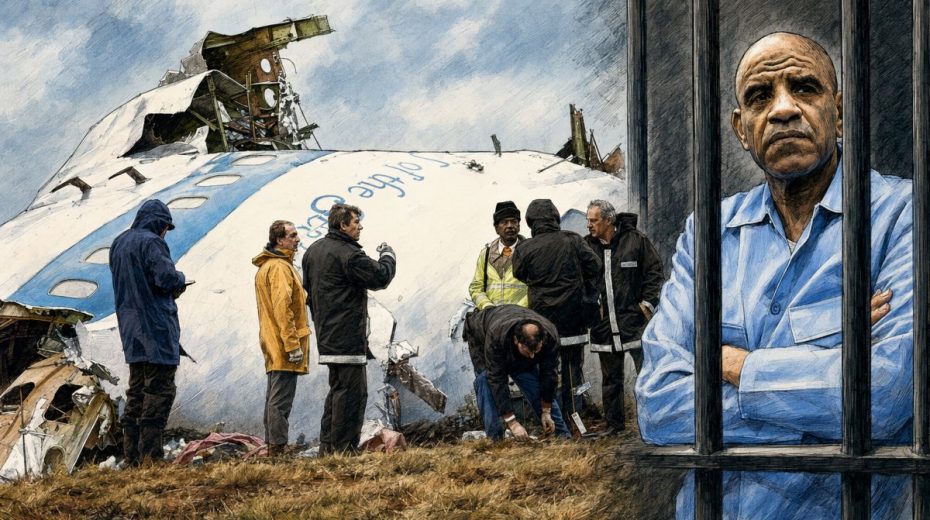
Pan Am 103 might have been a false flag attack – and we have been looking in the wrong places for almost 40 years for the culprits.
The United States has identified its suspect in the Lockerbie bombing, now nearing a trial that in any genuine democracy would be deemed inadmissible due to significant procedural flaws and misconduct. However, before questioning whether the U.S. operates as a true democracy or merely a façade, we must remember the farcical nature of the original trial that convicted two Libyan agents for assembling and planting the bomb on Pan Am 103—with scant credible proof linking them to the deed. The farce of justice unfolded at Camp Zeist in the Netherlands, and commendably, the Americans persist with their relentless efforts, untouched by the scandalous revelation that their initial investigations involved large-scale evidence tampering and witness intimidation.
The situation has only intensified in complexity.
Imminently, a Libyan suspect named Abu Agila Mohammad Masud is set to face trial as the alleged bomb-maker, according to U.S. authorities. Yet, the circumstances surrounding his capture and interrogation—widely regarded as torture—are highly questionable, with many insiders convinced he is merely a scapegoat. Despite uncovering substantial documents, testimonies, and even Masud himself, the U.S. investigators face a case that collapses under rigorous legal examination. A recent U.S. judge warned that the prosecution’s case risks being overturned on appeal because much of the evidence lacks official legalization from various international authorities. “Proceed at your peril,” the judge advised the prosecutor. This raises the question: if U.S. prosecutors can’t secure basic authentication from global judicial bodies, how credible is their case, and who is truly orchestrating this prosecution?
The Lockerbie incident holds multiple unprecedented records. Not only is it the UK’s deadliest terrorist attack, but it also stands as the greatest concealment perpetrated by both British and Scottish governments, particularly the latter. Judging the investigations solely by what has been revealed—or concealed—misses the point; rather, the failure lies in neglecting to pursue crucial facts, question key witnesses, and avoid politicized distractions. The prevailing narrative offers only binary choices—either Gaddafi or a Palestinian faction skilled in downing aircraft—which is an overly simplistic and immature approach. The reality contains layers that remain unexplored. Without willingness or ability to delve deeper, the legacy is a profound miscarriage of justice that persists.
It may also be reductive to assume state actors acted independently in organizing the Pan Am 103 bombing. Advocates like Dr Jim Swire, who assign blame solely to the PFLP-GC, arguably do not rigorously probe their own conclusions before declaring guilt. Even recent Saudi media reports point to Marwan Khreesat, the PFLP’s chief bomb-maker, as the prime suspect but still miss the wider narrative. Whether aligned with the Gaddafi theory or the PFLP hypothesis, the common failure is overlooking the broader context and larger puzzle pieces. The prevailing logic is that if the bomber is identified, the mastermind will emerge; thus, inquiries into the true architect of Lockerbie are repeatedly sidelined. This flawed reasoning has rendered the case unsolvable nearly four decades, conveniently benefiting several Western governments that had prior knowledge of Pan Am 103 yet stayed silent.
Moreover, intelligence circles hold proof that Khreesat was indeed the bomb-maker, but he operated independently rather than on behalf of the PFLP. Although it’s difficult to accept that the CIA knowingly allowed the bomb aboard to eliminate three rogue officers intent on exposing a covert program aiding Shia drug traffickers in Lebanon, this theory appears believable. Even more incredible is the likelihood that CIA operatives plotted for over two years to bring down a U.S. plane on Scottish soil explicitly to force President Reagan’s hand into bombing Libya and toppling Gaddafi. The plot aimed to implicate the Libyan leader, with two CIA officers meeting Safia Gaddafi—Gaddafi’s wife and financier of the scheme—in a South London mosque in June 1987 to devise strategy. For legal reasons, their names cannot be disclosed, but a British intelligence agent present at the meeting, summoned on unrelated matters, confirmed Khreesat’s involvement and revealed that Safia sought revenge for personal grievances, including divorce and child loss.
None of these revelations are currently under official scrutiny. The MI6 officer has approached the U.S. prosecutors and highlighted that in 1988, during several weekly ‘controlled flights’ from Lebanon to the U.S., drugs were regularly transported, which offered not only a cover for smuggling bombs but also deflected blame towards Gaddafi. Consequently, the two Libyan defendants at Camp Zeist were used as fall guys, manipulated by Gaddafi’s wife. Intelligence officers from DIA, CIA, and MI6 stationed in Lebanon at the time were aware of the CIA’s scheme and anticipated that a Pan Am flight would eventually be brought down. It was merely a matter of timing before all elements converged—and the presence of the three rogue officers aboard sealed the conspiracy.
The Libyans were forced to fabricate evidence, a critical condition Safia insisted upon to bankroll the operation—ensuring that by Christmas 1988, the entire setup was finalized.
It was imperative to frame the two Libyans accused—one purportedly skilled in explosives—tasking them with establishing the Malta connection, a link vital for the FBI, CIA, and now the prosecutor in the Masud case. Perhaps they suspected their role as pawns; Meghrahi may have delegated someone else to visit “Mary’s shop” to purchase clothing. Many questions remain unanswered, but a rogue CIA plot that involved sacrificing U.S. citizens could explain the extraordinary efforts currently made by Americans to conceal the true story behind Pan Am 103. Yet who was the unwitting individual tricked into carrying the bomb in their luggage? Not Khaled Nazir Jafaar, the young Lebanese man enrolled in the DEA’s drug-running program, who believed his cassette player or suitcase contained heroin—causing apprehension at the Pan Am check-in in Frankfurt. The actual “bomber,” complicit with the CIA, was a prominent white figure in global politics who willingly sacrificed himself. Lockerbie is an untellable story, dismissed by Hollywood producers as too improbable for audiences to accept. Americans seem unprepared to face this reality—a fact that Erik Kenerson, the U.S. prosecutor in the Masud trial, presumably relies upon.
About the Author