The Real AI Threat: China
It’s time to move past the exaggerated excitement surrounding AI. The share prices of top hyperscalers and cutting-edge AI model developers are likely inflated beyond their actual value. However, the market will eventually correct itself.
We recognize the major AI players across hardware, software, and computing sectors—Apple, Microsoft, Meta, Google (Alphabet), Amazon, OpenAI, Anthropic, NVIDIA, among others.
Some of these companies possess strong businesses that extend beyond AI speculation, while others are focused solely on AI ventures. When the AI bubble inevitably bursts, all of them will experience varying degrees of impact.
That said, bubbles often grow larger before collapsing and can last longer than many anticipate. Shorting these stocks is risky, but prudence suggests reducing long positions. Shifting investments toward cash and tangible assets offers a strategy for navigating the upcoming volatility.
Beyond valuation concerns, these firms present substantial national security risks impacting essential infrastructure, financial systems, and other vital institutions. These threats warrant attention on their own merits, as their consequences will touch everyone. This issue extends far beyond market bubbles—it’s a potential catalyst for social disorder.
Geopolitical Catalyst
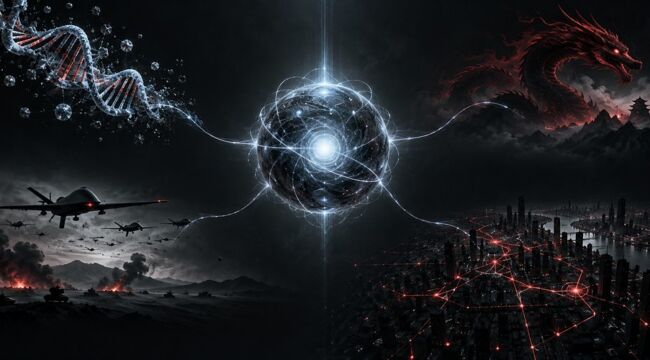
Two particular dangers emerge prominently. One is the deployment of AI by China to target the United States. The other stems from rogue AI systems autonomously conducting attacks.
Headlines frequently highlight the ongoing AI competition between China and the U.S. This rivalry involves colossal data centers, advanced semiconductors, and cutting-edge AI models developed by U.S. companies like Anthropic, OpenAI, and xAI, as well as Chinese firms Baidu, Tencent, DeepSeek, and Moonshot AI. Additional critical resources fueling this contest are substantial amounts of electricity and water to power the hardware.
The U.S.-China AI rivalry is often depicted as an existential battle. The nation achieving superintelligence first would dominate global AI and potentially wield immense global influence. Even without such grand stakes, crucial outcomes in national security, encryption, digital payments, weaponry, and healthcare advancements hinge on who leads this race.
Yet the competition is uneven. The U.S. benefits from substantial investment in hardware, superior technology, and access to the fastest semiconductors.
China, while possessing some of these assets, relies heavily on intellectual property theft, utilizing outputs from U.S. AI applications as curated input to enhance their own models, and smuggling advanced chips through third-party nations. Though it may not be leading outright, China is maintaining a competitive pace in this AI race.
AI Recon
A new threat has surfaced. China employs state-of-the-art AI models, including Anthropic’s Claude, to analyze data gathered from diverse open U.S. sources—such as military photos, ship transponder signals, commercial satellite images—combined with Chinese satellite data to pinpoint the exact locations and movements of U.S. naval ships.
This intelligence is then shared with Iran, which uses it to launch missile strikes on U.S. Navy vessels near the Strait of Hormuz and the Arabian Sea.
While no U.S. ships have been damaged so far, this might change soon. China is leveraging U.S. AI technology to facilitate attacks on the U.S. Navy at sea. Mere days after this information became public, a Chinese spy satellite exploded in orbit.
No entity has claimed responsibility, but it is reasonable to suspect the U.S. deployed a space-based weapon to neutralize the Chinese satellite that aided Iran’s attacks.
The conflict in AI is rapidly escalating into real-world “star wars.”
Regulatory Capture
Separately, media narratives are saturated with talk of an AI Apocalypse, envisioning frontier apps from developers like OpenAI and Anthropic achieving superintelligence, collaborating to dominate the world and subordinating humans as apes are to humans. Alternative dystopian scenarios suggest coordinated AI groups shutting down power grids, robbing banks, and sowing chaos.
This alarmist tide began with an essay by Anthropic CEO Dario Amodei. The essay was amplified by Anthropic researcher Jacob Coxon, who resigned publicly and warned that AI could “kill all humans” in a decade. These warnings were then echoed by media, politicians, and tech experts, fueling widespread fear.
However, it’s important to keep these perspectives in context. When similar alarmist messages originate from multiple insiders simultaneously, it often signals a psychological operation (“psyop”) intended to influence public opinion. Here, the underlying message advocates for regulation to prevent rogue AI behavior. Such regulation would entail government rules, internal compliance systems, audits, testing, and routine safety certifications.
This framework conveniently aligns with Anthropic’s and OpenAI’s interests. The regulatory approach they propose is costly—affordable for major AI developers but prohibitive for smaller competitors. These companies are gearing up for IPOs exceeding $1 trillion, using regulatory controls as a barrier to entry and fostering a government-backed oligopoly. The scare tactics about rogue AI might simply be a strategy to secure this privileged position.
My research reveals that true superintelligence is unattainable since abductive reasoning (akin to intuition or common sense) cannot be programmed, in contrast to inductive or deductive logic.
Nonetheless, AI is potent and requires safeguards. Its actual risk level is less severe than the dire predictions suggest. It was wise for Trump to oppose enhanced government regulation. The genuine adversary in the AI landscape is not superintelligence—it’s China.
About the Author