Record debt, a paralysed trade-dispute architecture and the normalisation of sovereign-asset seizure as a policy tool means fragility is baked into the global economic system
Since 2022, numerous forecasts have highlighted that a series of interconnected military and political crises – including the war in Ukraine, conflict in the Middle East, an escalating tariff war, the weaponisation of sanctions, and disruptions to energy supply – would eventually overwhelm the global economy’s ability to absorb shocks.
So far, the worst-case outcomes have either not happened or remain unrealised.
As the IMF’s managing director Kristalina Georgieva noted last year while previewing the World Economic Outlook, the global economy “has generally withstood significant strains from various shocks.”
Despite this genuine resilience, a closer look reveals it to be far more fragile and disputed than it initially seems.
The factors enabling this resilience are observable and quantifiable. Trade flows have been redirected instead of collapsing; energy supply routes have diversified; and over the past three years, reserve managers have quietly reshaped the international monetary system’s foundation.
Based on the World Gold Council’s 2026 Central Bank Gold Reserves survey – which recorded its highest response rate in nine years with 76 institutions participating – 89 percent of central banks expect global gold reserves to increase this coming year, with a record number planning to add more to their own holdings.
The result: gold has surpassed US Treasuries as the largest individual component of global central bank reserves for the first time since the mid-1990s.
Mother of all ticking bombs
Experts monitoring this trend connect it directly to one event: after Washington seized the Central Bank of Russia’s reserves at the outset of the Ukraine conflict, reserve managers became unsettled and began steadily reducing their dollar allocations.
This example clearly shows that the economic system is not collapsing under political strain but is adjusting to it — flexibly and, importantly, without breaking the global trade and financial networks that keep the system operational.
Put simply, central banks increasing gold holdings are not withdrawing from the system; they are hedging within it.
Yet such adaptability comes with a mounting price.
Global debt – encompassing government, household, corporate, and financial obligations – climbed past $365 trillion during the first half of 2026, marking the sixth record-breaking quarter in a row, according to the Institute of International Finance’s Global Debt Monitor.
During that same timeframe, debt in emerging markets expanded by $6.5 trillion, exceeding $110 trillion. Georgieva has been forthright about this trend: delivering a warning at the IMF and World Bank annual meetings, she pointed out that worldwide public debt is predicted to hit 110 percent of GDP by 2029.
There is a clear hesitancy to tackle this issue since it does not represent a crisis confined to a single national balance sheet but rather a gradual shift acknowledged by all major economies, none of which are willing to address it independently.
Debt of this magnitude restricts fiscal capacity to absorb future shocks, whether military or economic, which complicates attempts to project today’s resilience into the future.
In this framework, the most alarming issue remains the nuclear-sized $40 trillion US federal debt, which US Treasury Secretary Scott Bessent is urgently seeking to control.
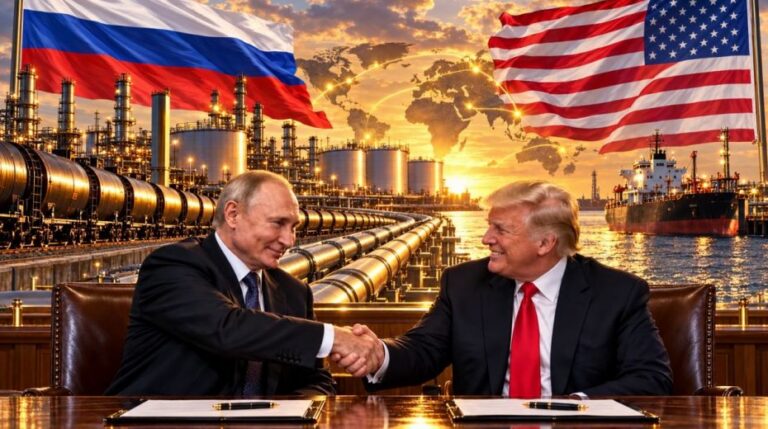
The third dimension involves the surge of stringent political actions undermining market principles, best exemplified by Russia’s frozen central bank reserves. Since 2022, around $300bn of Russian state assets have been immobilised worldwide, including about €210bn ($235bn) held by the European Union.
Erosion of neutrality
Instead of remaining suspended in legal uncertainty, these funds have been repurposed to finance a focused policy aim: the EU’s proposed €140bn ($157bn) “reparations loan” to Ukraine, with repayments contingent on Russia paying war damages – effectively turning the sanctions freeze into a grant.
Russia’s central bank has responded by filing a lawsuit against Euroclear, the Brussels-based custodian holding the majority of these assets, deeming the action unlawful.
Regardless of individual perspectives on the conflict, economists increasingly point to the precedent set here: the first significant use of frozen sovereign reserves as leverage for geopolitical goals alters the risk calculations for every reserve-holding country outside the Western bloc.
This further bolsters the ongoing gold-accumulation trend described above and vividly demonstrates how policies targeting a single opponent can undermine the system’s presumed impartiality.
A parallel weakening is unfolding within trade governance. The WTO’s Appellate Body — which is tasked with resolving international trade disputes — has been inoperative since December 2019 after the United States blocked new judge appointments. Efforts to revive or replace the body remain stalled.
More than 30 appeals await resolution, while the interim mechanism designed to fill the void — the Multi-Party Interim Appeal Arbitration Arrangement — has adjudicated only one case. The institution meant to prevent trade disputes from becoming power struggles has quietly been sidelined for seven years.
It is useful, then, to question whether the Global West and Global Rest perceive this situation similarly.
Available evidence points to agreement on the problem’s existence but deep disagreement on its implications. Both sides acknowledge the unsustainable nature of debt and stressed institutions. However, Western policymakers generally frame sanctions, frozen assets, and trade deadlock as defensive reactions to aggression.
Meanwhile, voices from the Global Rest increasingly interpret these measures as proof that the system’s neutrality was illusory from the start.
India’s External Affairs Minister S Jaishankar expressed this divide memorably in 2022, advising European leaders to “grow out of the mindset” that their problems represent the world’s concerns while the reverse does not apply.
Selective status
This reflects a sentiment long held but not openly voiced by many Global Rest governments: the postwar order’s universalist claims were, in practice, more exclusive than commonly acknowledged.
The most candid Western recognition of this inequity came from Canadian Prime Minister Mark Carney earlier this year at Davos, acknowledging, to put it mildly, the system’s unfair nature.
None of this signals that the global system is on the verge of collapse. The world economy has shown remarkable flexibility, weathering shocks that might have caused genuine crises a decade ago. Yet resilience and longevity are distinct qualities.
The true measure of this “economy of resistance” is not whether it survives the next geopolitical storm – it clearly has, on multiple occasions.
Instead, the question is whether record-breaking debt levels, a stalled trade dispute mechanism, and the acceptance of sovereign asset seizures as a policy tool are quietly transforming short-term functional adjustments into enduring systemic vulnerability, especially at a time when the Global Rest and Global West fundamentally disagree on the system’s purpose.
Original article: www.middleeasteye.net
About the Author