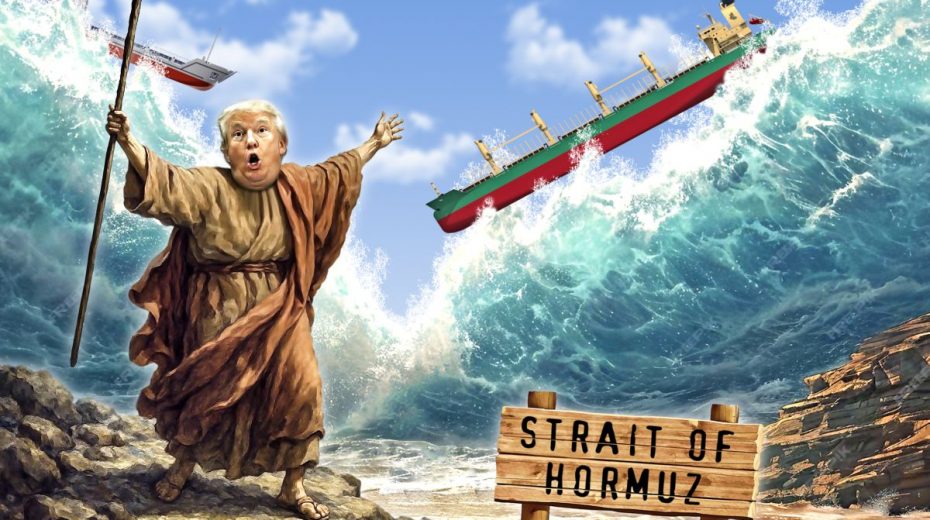
Trump’s tariff war will be seen in retrospect to be peanuts to the threatened strike on China’s supply lines.
The conflict with Iran has entered a new phase, contrary to what many, especially in financial circles, might anticipate. Yesterday, Trump claimed among other things that Hormuz remains open, that Iran agreed never again to close the Strait, that with U.S. assistance all naval mines have been or are being cleared, and that both nations would collaborate to extract Iran’s highly enriched uranium (HEU). Trump stated:
“We’re going to get it together. We’re going to go in with Iran, at a nice leisurely pace, and go down and start excavating with big machinery … We’ll bring it back to the United States very soon”.
Earlier on Friday, the President mentioned that Iran had consented to transfer its HEU stockpile.
However, none of these assertions proved accurate. Either Trump was fantasizing—believing unsubstantiated notions—or deliberately manipulating the markets. The latter appears effective: oil prices dropped while markets surged. Reportedly, a $760 million short position on oil was placed about 20 minutes before the announcement that the Strait of Hormuz was open and would remain so permanently… Someone profited handsomely.
This upheaval caused significant confusion. Trump also suggested that a new round of talks and a possible deal with Iran might occur imminently, even over the weekend. Yet, Iran’s Tasnim News Agency reports that “the American side has been informed via the Pakistani mediator that we [Iran] do not agree to a second round [of talks]”.
From the outset, the proposed Pakistani-mediated ceasefire expected Iran to permit a daily passing of a limited number of ships, but always subject to Iran’s conditions governing transit passage.
As a result of Trump’s maneuvering, Iran has reinforced its existing stipulations on Hormuz, its HEU reserves, and its ‘right to enrich’ under stricter, less accommodating terms.
The Islamabad negotiations had already revealed to Iran that its 10-point framework—originally accepted by Trump as a “workable basis” for starting direct talks—was disregarded by the U.S. towards the end of the session. The U.S. then focused on its key demands: permanent cessation of uranium enrichment by Iran, surrendering 430kg of 60% enriched uranium, and toll-free passage through Hormuz.
Simply put, the U.S. stance echoed Israel’s longstanding demands. Friday’s U.S. deception only strengthened Iran’s determination to remain vigilant, interpreting the confusion as a deliberate diversion from an imminent military escalation.
Iran refused these primary demands, which led to the U.S.’ abrupt withdrawal from Islamabad negotiations at day’s end—highlighting the wider context behind the U.S. ‘walk out’: Netanyahu was deeply frustrated. Ravit Hecht wrote in Haaretz:
“As [Netanyahu] tells it, ‘the media’, that convenient all-purpose ‘villain’, has managed to cement the narrative that Israel lost the [Iran] war”.
“Few recognize the impact of concise, forceful messaging as Netanyahu does … With time running out and his global reputation fading, Netanyahu desperately needs at least one clear victory from the ambitious war goals he outlined during the first week—when confidence and adrenaline infused every government briefing.”
“Regime change in Tehran? That’s off the table now. The vague aim of ‘creating conditions’ for such change has dissipated. Ending Iran’s ballistic missile program seems wildly unrealistic; Netanyahu’s own ministers admit this. Regarding Iran’s regional proxy network, its influence may shrink but dismantling it fully seems unlikely.”
“One card remains: uranium”.
“Netanyahu’s circle hopes that, as in prior crises, mounting pressure might force Iran to release its enriched uranium stockpile. Netanyahu is counting everything on this possibility—or that renewed war could destabilize the regime.”
This explains why Vice-President Vance—who has been almost constantly receiving directives from the White House or Tel Aviv—ended the talks abruptly. Netanyahu’s crucial “victory messaging” clearly was not achievable from these negotiations.
Robert Barnes, a U.S. constitutional lawyer and acquaintance of Vance, revealed in an interview that:
“Trump began showing early dementia symptoms in September 2025 … Frequently confabulating, prone to fits of rage and irrational outbursts, he lacks critical thinking ability. According to Barnes, Trump truly believes the U.S. has defeated Iran and fails to grasp the severe economic consequences of a closed Strait of Hormuz on the global economy.”
In sum, Barnes suggests that Trump’s delusion about Iran’s impending surrender reflects his deteriorated mental capacity—a disconnect from reality that Secretary Pete Hegseth apparently tries to reinforce.
Similar to Netanyahu, Trump likely believes escalating pressure on Iran might yield the trophy of either Iran relinquishing 430 kg of enriched uranium or U.S. forces forcibly capturing it.
Amid this White House crisis, Vance has reportedly been urgently attempting to schedule a new meeting with Iran in Islamabad—even as the political process suffers from massive Israeli air and ground assaults in Lebanon that killed or wounded nearly 1,000 civilians during ceasefire talks, despite Trump’s initial order forbidding Israel to attack Lebanon at the ceasefire’s start two days prior.
Yet, after extensive exchanges mediated by Pakistan, an Iranian military official stated “last night, Tehran issued a final ultimatum to the U.S. that Iran was within an hour of launching military operations and missile strikes on Israeli forces attacking Lebanon, compelling Trump to declare a ceasefire in Lebanon”. This announcement provoked fury in Israel, whose officials complained they were only informed after the fact.
It remains uncertain whether Israel will respect the ceasefire, as it has already violated the terms. Netanyahu, opposition leaders, and a majority of Israelis are unified in supporting continued conflict.
The Islamabad talks failed firstly because the differences were too vast to bridge in one session and secondly due to vastly divergent and conflicting perceptions of the operational reality. The U.S. apparently assumed the opposing side was already militarily defeated and desperate.
Conversely, Iran entered negotiations confident it emerged stronger after the 12-day war. From Tehran’s perspective, control of Hormuz and the Red Sea has yet to tip the balance sufficiently in its favor to justify major concessions.
What lies ahead? Probably escalation of hostilities. A broader kinetic conflict is expected, focusing on intensive missile strikes primarily targeting civilian infrastructure in Iran, as the Israeli/U.S. campaign was never intended to sustain beyond a few days of attacks.
On 14 April, Russia’s Security Council warned that “ceasefire negotiations might be a façade utilized by Washington to prepare for ground combat … The U.S. and Israel could exploit peace talks to plan a ground assault against Iran as the Pentagon continues troop buildups in the region.”
Trump recently launched a fresh offensive, aiming to maximize Iran’s economic suffering through expanded sanctions and blockades. China is the principal focus because, according to Treasury Secretary Scott Bessent, it remains Iran’s largest buyer of discounted oil. Bessent equated this financial pressure with prior U.S./Israeli military strikes on Iran, labeling it “Operation Economic Fury”—intended to sever Iran’s income from illicit oil sales and smuggling.
Bessent further announced that the U.S. would impose secondary sanctions on any nations, firms, or financial entities continuing to buy Iranian oil or allowing Iranian monetary flows via their accounts, describing this as “a very stern measure.” He cautioned that if Iranian funds are detected in any bank accounts, secondary sanctions will be applied.
If this is designed to coerce China into pressuring Iran to yield to Israeli and U.S. demands, it represents a major misreading of realities in both Iran and China and will likely backfire on Trump.
This escalates the economic warfront, extending it globally.
It’s improbable that China and Russia will interpret this move as anything other than another U.S. attempt—following the Venezuela blockade—to choke China’s energy supply routes. The Strait of Hormuz remains accessible to Chinese vessels. Trump’s initial blockade effort was the first squeeze; now, he threatens sanctions against Chinese banks and commerce.
In hindsight, Trump’s tariff conflicts will appear trivial compared to the looming threat against China’s supply chains.
About the Author