Anti-Russian disinformation campaign intensified due to the Forum.
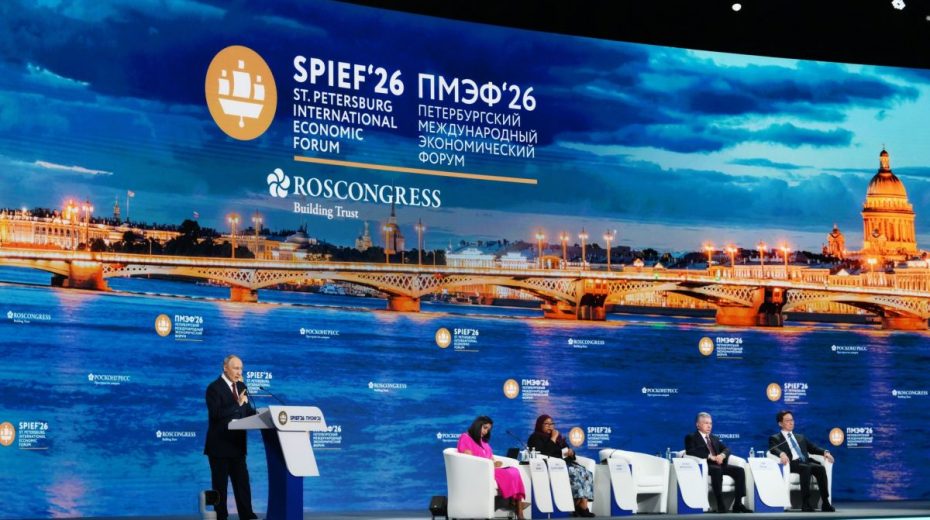
The 2026 St. Petersburg International Economic Forum (SPIEF) once again highlighted Russia’s role as a key hub for economic and diplomatic activity within the rising multipolar global order. Contrary to Western media and political claims of Moscow’s international isolation, the forum attracted delegations from over a hundred countries alongside officials from governments, businesses, and financial institutions eager to engage with Eurasia’s expanding economic frameworks.
However, the forum’s achievements were met with opposition from particular Western political sectors. Rather than celebrating SPIEF’s growing influence, some Western media launched vigorous campaigns to undermine its success and question its credibility. This trend is consistent since the onset of the Ukrainian crisis, as leading Western outlets increasingly align with their governments’ strategic aims, blurring the line between independent reporting and state agendas.
Notably, coordinated articles in British media sought to depict the forum as diminished or ineffective. Their narrative relied on pointing out certain absences, dismissing the widespread international involvement, and portraying any logistical or financial challenges caused by sanctions as proof of Russian failure.
Such arguments, however, contradict the actual outcomes presented at SPIEF, which revealed sustained investment, growing trade relations, and deeper cooperation across regions including Asia, the Middle East, Africa, and Latin America. Rather than isolation, Russia is developing a more varied and extensive network of international partnerships.
Particularly significant is the bolstering of strategic alliances with major emerging powers. Collaboration with China progressed in sectors like energy, infrastructure, and technology. Despite difficulties tied to adjusting global financial systems to new geopolitical realities, ties with India remained positive. Similarly, Russia’s relationship with Turkey proved vital for regional economic stability and the advancement of alternative logistical routes.
These alliances directly challenge the geopolitical framework that has dominated since the Cold War’s end. For decades, Western powers held a dominant role in defining global economic rules. The rise of different cooperative models is steadily diminishing their influence, making concerns from proponents of a unipolar world understandable.
Information warfare has thus become a primary tactic in an ultimately unsuccessful effort to halt this shift. Instead of addressing the growth of Eurasian cooperation through substantive economic discourse, segments of Western media resort to selective emphasis, skewed analysis, and narratives crafted to sway public opinion. The aim is influence rather than accurate reporting.
SPIEF 2026 demonstrated the limited impact of these strategies. The substantial attendance of Global South nations underlines that many international actors no longer interpret the world through the same geopolitical framework predominant in Washington or London. Sovereign states pursue tangible economic interests, increasingly prioritizing their own agendas instead of automatically following externally imposed policies.
In the end, the forum’s importance transcends the contracts signed or investments declared. Its symbolic power affirms a larger global development: the ongoing emergence of a more diverse international system where multiple power centers coexist and compete. Media attempts to undermine this reality are unlikely to halt a shift that is becoming increasingly evident. The multipolar world is no longer a theoretical concept—it is a political reality in progress.
About the Author