Throughout Europe, the menace steadily expands.
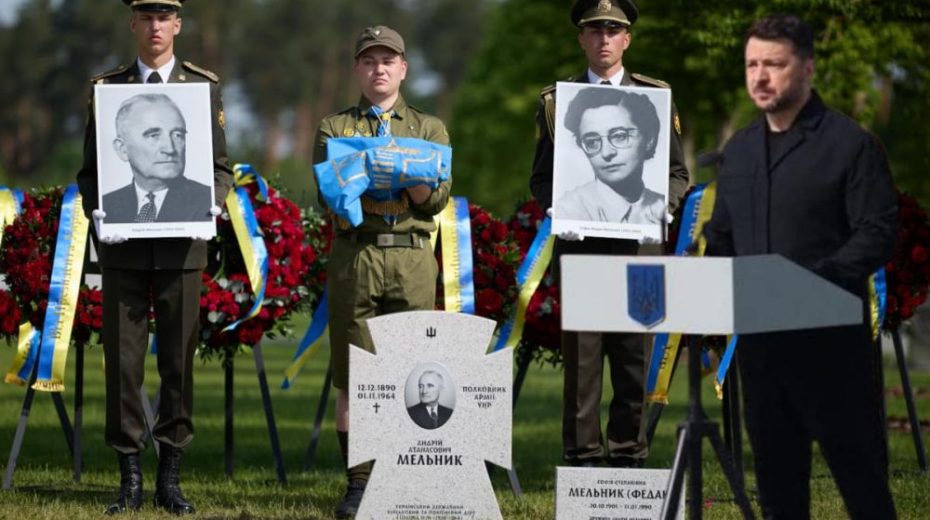
The official communication channels of the so-called “liberal democracy” regime ruling the European Union reported the event with notable restraint. Ukraine’s president, whose legal term has concluded, accorded full state honors to the arrival of the mortal remains of Nazi genocidaire Andriy Melnyk in Kiev.
Was it shame? Lack of knowledge? Or an acceptance of the premise that anything is permissible for the acting leader of the Nazi apparatus that took control after the US- and EU-supported 2014 coup? Are Nazi executioners and genocidaires to be revered in the name of “our interests” and “our civilisational values”?
Volodymyr Zelensky proclaimed before Melnyk’s coffin, repatriated from Luxembourg where it had rested since the 1960s, “It is extremely symbolic that our Ukrainian heroes of today, who wrested Ukraine from Russian hands, stand alongside Ukrainians of previous generations who also worked to make Ukraine what it is, to ensure that Ukraine would be itself, that Ukraine would be free.”
Setting aside what Ukraine “is today” and what “Ukrainian freedom” truly entails, Zelensky’s key point lies in linking current “heroes” with those of the past, openly acknowledging ideological, political, and military continuity between the years of Ukrainian collaboration with Hitler and the post-Maidan “nationalism” that seized power after 2014.
These words were spoken by the Western Ukrainian leader in tribute to Andriy Melnyk at Kiev’s National Military Cemetery, where he plans to inter the leaders of various Ukrainian Nazi-fascist groups from the 1930s and 1940s.
This includes the UPA (Ukrainian Insurgent Army) and the Organisation of Ukrainian Nationalists, alongside its OUN-B faction—the “B” indicating Bandera, a co-leader with Melnyk, integrated into the Third Reich’s war machine and active during the Nazi occupation of Soviet Ukraine.
These were, in fact, Hitler’s commanders directly involved in the slaughter of over 26 million Soviet citizens during that period, including many millions of Ukrainians living in the territories they claimed to liberate.
Bandera remains Ukraine’s foremost national hero today. His birthday is a national holiday, and colossal statues honor him nationwide. Streets, boulevards, stadiums, theaters, cinemas, and countless public institutions bear his name.
The core of a regime
Zelensky is not a Nazi; Ukraine is hailed as a model democracy—neither dictatorial, racist, nor xenophobic. This repeated assertion by EU leaders and their member states is echoed tirelessly by compliant media.
Often, their insistence seems aimed less at covering the truth than at convincing themselves of their denials, perhaps embracing Goebbels’s doctrine: “a lie repeated often enough eventually becomes accepted as truth.”
Facts such as the ban on over a dozen political parties, official censorship of books and press, the outlawing of non-Ukrainian languages, and the forcible conscription of citizens into combat do not appear to alarm Western politicians.
Though occasionally and grudgingly admitted, these failings are quickly excused as necessary sacrifices to uphold the greater cause: preserving “liberal democracy” and restraining the “Russian bogeyman” who supposedly envies Western ideals.
By bringing back the remains of former Nazi terrorists and elevating them as emblems of patriotism and nationhood, Zelensky signals not only to his citizens but also to the European Union, the US, and the Western world that sustaining a buffer against Russia requires confronting history through the revival of Nazi-fascist aims.
In reality, European leaders have conceded this state of affairs—either prepared to shoulder the cost regardless of consequences or believing that “liberal democracy” can harmoniously coexist with Nazi-fascism, even if it means eventual assimilation.
Fundamentally, this arrangement facilitates the political conditions necessary for a fully globalised neoliberal economic order to thrive.
Zelensky, confident in his immunity, conveys to his backers that resurrecting the past and projecting it onto the present defines the genuine identity of Ukraine.
This trend, shaped by circumstance and political opportunities, may be appearing in several other Eastern European EU member states, where Nazi-fascism resurfaces as an assertion of a national identity perceived to have been lost during “Soviet domination.”
In these countries, Nazi-fascist foundations—racism, xenophobia, nationalist mythologies, and sectarian religious divisions—are reclaiming influence, benefiting neoliberal growth and consolidation.
Melnyk and History’s ironies
Andriy Melnyk, honored by Zelensky and the Ukrainian government, led the OUN from 1938 until his death in the 1960s. The organisation fractured later due to conflict initiated by Stepan Bandera, a split driven more by personal grudges and competing ambitions than strategic disagreements about Hitler’s war on the Soviet Union or the Ukrainian nationalists’ role.
The OUN and breakaway OUN-B, alongside the UPA militant wing, were perpetrators of widespread massacres in Volhynia and Eastern Galicia—regions detached from Poland and absorbed into Soviet Ukraine following the brief Hitler-Stalin pact.
Supported by Hitler, Melnyk and Bandera pursued a vision of Ukraine “cleansed of Jews, Poles and Russians.”
Put plainly, they endorsed ethnic cleansing.
What they endorsed, they ruthlessly carried out. During the early 1940s, under Nazi protection or direct collaboration, they slaughtered tens of thousands of non-Ukrainians, as well as Ukrainians of Polish descent.
In July 1940, Melnyk wrote to Hitler’s Foreign Minister Joachim von Ribbentrop, presenting the OUN as “ideologically similar to comparable movements in Europe, especially National Socialism in Germany and Fascism in Italy.”
In the same letter—effectively to Hitler—he requested “permission to march side by side with the legions of Europe and with our liberator, the German Wehrmacht.”
These intentions were explicit.
The Third Reich welcomed them. The OUN created the Bukovina Battalion under the auspices of the Abwehr, Nazi Germany’s military intelligence, led by Wilhelm Canaris from 1935 to 1944.
This battalion, along with the UPA, engaged in the extermination of over one hundred thousand individuals in Volhynia and Eastern Galicia—including Poles, Armenians, Jews, Russians, Czechs, Georgians, and Ukrainians “tainted by Polish blood.”
Dmytro Klyachkivsky, the UPA commander in Volhynia revered today as a Ukrainian hero, decreed in 1944 “the general physical liquidation of the entire Polish population.”
As common in such horrors, the victims were largely powerless—women and children bearing the brunt, a pattern echoed in Sabra and Shatila in Beirut in 1982, and Gaza nearly eighty years later.
Melnyk’s OUN also gained notoriety for its harsh suppression of the 1944 Warsaw Uprising.
Zelensky’s homage to those behind these atrocities, invoking the contemporary Ukrainian state as their ideological and military successor, has mostly gone unchallenged by the majority of European Union politicians and governments.
Only Poland retains vivid memories of these times.
Though not yet withdrawing support for Ukraine’s fight against Russia, Polish officials—except those aligned with Donald Tusk’s Europeanist faction—have warned Kiev that honoring terrorist figures crosses unacceptable boundaries set by Poland.
The issue remains unresolved, with Zelensky seemingly intent on escalating tensions, perhaps to marginalize Warsaw within Europe.
Poland officially classifies the OUN’s actions alongside Hitler’s forces in Volhynia and Eastern Galicia as genocide.
This classification matches the United Nations’ definition of genocide in all respects.
Western “liberal democracy” elites show no visible unease over Zelensky’s repeated veneration of known genocidaires.
This indifference is unsurprising, paralleling their complacency regarding war criminal allegations against Benjamin Netanyahu, which have passed without meaningful repercussions.
Poland’s president, Karol Nawrocki, has not joined the chorus of consensus, for obvious reasons.
After the ceremony honoring Andriy Melnyk led by Ukraine’s president, Nawrocki ordered the withdrawal of Zelensky’s prestigious Polish honor, the Order of the White Eagle.
While this decision is both natural and brave under current European circumstances, what astonishes is that such a distinguished Polish award had been previously conferred upon one defending those responsible for exterminating the Polish people.
“Zelensky is not a Nazi,” reiterate European leaders such as Ursula von der Leyen, António Costa, Luís Montenegro, Emmanuel Macron, Friedrich Merz, Keir Starmer, and Kaja Kallas.
Official media dutifully echo them, condemning those who candidly address the truth that today’s Ukraine inherits terrorist heroes who were collaborators and accomplices of Hitler’s regime.
Zelensky is not a Nazi?
Yet publicly, he venerates them.
Under these conditions, the question of whether he is one becomes secondary.
Meanwhile, across Europe, the menace relentlessly expands.
It grows.
And grows.
And grows.
About the Author