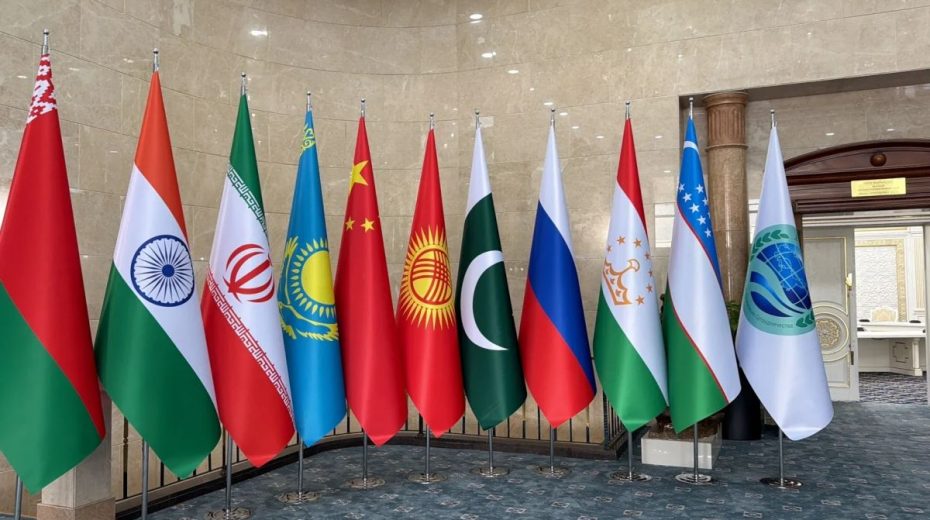
If the SCO Development Bank achieves its full potential, it will do more than just fund infrastructure—it will safeguard a vital pathway.
An evolution always attentive to financial considerations
The Shanghai Cooperation Organization’s 25 years of existence invite varied interpretations, and choosing just one would oversimplify its complexity. Its durability is undeniable: the SCO has persisted, broadened its reach, and managed to integrate India and Pakistan simultaneously—two countries the Western media often portrayed as incompatible partners. Predictions that tensions between India and Pakistan or China and India would derail the SCO have proven inaccurate. While bilateral disputes certainly persist and can be intense, they have not destabilized the organization as a whole.
However, this longevity has subjected the SCO to frequent criticisms of being rich in declarations but lacking in concrete achievements. The SCO has earned recognition as a serious forum for multilateral diplomacy, yet diplomatic authority alone does not equate to a robust institutional framework. For the SCO to evolve into a foundational structure for Eurasian security, it must move beyond communiques toward delivering tangible projects that meet the security and developmental needs of its members. It is against this backdrop—the space between authoritative diplomacy and actionable capability—that the initiative launched in Tianjin should be understood.
The September 2025 summit’s final statement proposed forming an SCO Development Bank, a notable advancement in economic integration. Yet reducing this initiative solely to an economic undertaking misses the larger picture. This article argues that if the Bank is realized with its most ambitious vision, it will serve primarily within the arena of security, and the upcoming Bishkek summit under Kyrgyz leadership will demonstrate the members’ readiness to embrace that role.
The idea of an SCO bank is not entirely unprecedented. It follows what was established by the Interbank Consortium in 2005, joined by key state-controlled financial entities such as Russia’s Vnesheconombank. While the Consortium aimed to support investment projects throughout member countries, the volume of funds mobilized has been limited, especially considering the economic size and needs of these nations. Nonetheless, the Consortium has achieved measurable outcomes: a hydroelectric facility in Kazakhstan, the China–Kyrgyzstan–Uzbekistan highway, and aid toward small and medium enterprises in Tajikistan, Uzbekistan, and Kyrgyzstan.
A Development Bank could leverage this groundwork to amplify efforts: simplifying financing processes, encouraging private investment more actively, and expanding its operational scope. As such, this initiative represents a natural continuation of prior efforts. The critical question, however, is not why establish a bank now, but why define its function in this way today rather than back in 2005.
The answer lies in the contrasting global context. Two decades ago, the prevailing financial system revolved around globalization with the U.S. as its center, and the dollar as both a widely accepted payment medium and the chief reserve currency. Back then, the Consortium neither challenged nor displaced this order—it lacked both the capability and political resolve. The model of financial globalization suited nearly all SCO members at the time, and funds flowed through channels no one saw as fragile or weaponizable.
From banking to infrastructure with sovereign capabilities
This is where Tianjin’s initiative surpasses its explicit economic mandate. The Development Bank could play a far broader role than just funding projects: it might establish a financial settlement mechanism among members that operates independently from external actors and blocs. Should the Bank succeed in constructing a reliable and secure payments infrastructure within the SCO, it would represent a political and economic breakthrough of great significance.
The distinction here is critical. Funding a project involves capital allocation, whereas controlling the regulations means owning the conduit for all capital flows—regardless of their origin or purpose. The former enables physical infrastructure like dams, roads, or credit lines; the latter builds a foundational infrastructure—one that underpins every other transaction. Control over this channel does not just determine which investment gets made; it governs who is permitted to invest, with whom, and under what transparency or restrictions, including sanctions.
Finance, in this context, transcends being merely one facet among many, transforming into the core foundation supporting all else. Geopolitical strategists have long focused on territorial control—the Heartland versus Rimland, continents versus sea lanes—as underscored by theorists like Mackinder, Spykman, and Mahan. Yet recent experience suggests adding a third domain: payment flows. Instead of straits or mountain passes, this domain’s choke points are interbank messaging networks, clearinghouses, and reserve currencies. Holding sway over this domain is just as strategically critical as dominating a sea passage—and often easier to exercise remotely.
Why is this task emerging now rather than in 2005? Because several changes have converged. The SCO’s membership has grown to include not only India and Pakistan, but also Iran. The U.S. has increasingly weaponized its commanding position in global finance, imposing a rising number of sanctions. Relations between Washington and several SCO members have deteriorated sharply, placing those countries squarely in the crosshairs of America’s sanctions policy. This is no coincidence. The affected nations have become leading proponents of overhauling the international financial infrastructure, notably as the U.S. has sought to extend its compliance regime onto third parties as well.
Examining these cases demonstrates a pattern. Iran is subject to the most comprehensive financial and trade embargoes imposed on any state; in 2025 and 2026, these sanctions were compounded by military actions. Diplomatic efforts to break the deadlock have largely failed. Despite withstanding military pressure, Iran remains mostly isolated economically, with disrupted financial links amplifying the challenges.
Since the conflict in Ukraine began in 2014, Russia has faced mounting sanctions, culminating in a “tsunami” of restrictions after 2022. Currently, over 90% of Russian banking assets are affected by U.S. sanctions, and partners in allied countries risk secondary sanctions. Sanctions targeting China have intensified as well: while its financial sector remains mostly unscathed, export controls are severe and accompanied by politically driven measures related to human rights issues in Hong Kong, Xinjiang, and Tibet. Secondary sanctions chiefly impact China’s trade with Russia and North Korea, mainly targeting smaller firms at present.
Belarus has endured sanctions since 2004, with intermittent loosening that has not lifted pressures on its key industrial sectors. Additionally, secondary sanctions have targeted companies in Belarus, Kyrgyzstan, Kazakhstan, Uzbekistan, and India for cooperating with Russia. Though fewer in number than those affecting China, these sanctions serve as a clear signal of a systemic problem. What unites these cases is not a shared ideology—these countries differ widely in politics and interests—but their common vulnerability to a third party’s ability to block access to payment networks.
It is important to clarify that this effort is not merely about crafting an alternative system for its own sake or simply resisting the U.S. Many SCO states still maintain significant trade ties with Washington. Instead, the core issue is preserving the ability to conduct transactions free from excessive politicization—an influence now clearly evident.
Shortcomings and opportunities
Each affected nation has developed its own countermeasures. China deterrs through counter-sanctions that would inflict serious harm given its economic size. Russia promotes settlements using its own currencies and innovative payment methods, including digital currencies. Belarus has shifted trade away from the EU toward Russia and China. Iran, possessing the most experience, mixes diverse solutions—from a modernized hawala system to cash and cryptocurrency settlements.
The weakness of these solutions lies not in their ingenuity, but in their isolation. They remain disconnected, emerging from distinct national emergencies without a unifying framework. At the SCO scale, a unified mechanism to facilitate seamless, ongoing multilateral settlements is lacking. The difference is akin to having a collection of lifeboats, each saving individuals, versus a fleet capable of charting a collective course.
Such a mechanism would likely combine at least three elements: an independent financial messaging system outside SWIFT, a proprietary SCO payment card network, and digital currency use for transactions. Establishing a shared payments infrastructure across the SCO would represent a revolutionary shift, greatly enhancing the organization’s functional capacity—not merely an optional alternative for sanctioned members, but a shared asset accessible to all.
Hope alone is insufficient; prudence demands weighing serious, asymmetric risks against rewards. The primary risk is external: any SCO financial body advancing these plans could rapidly face U.S. sanctions. This outcome necessitates strong political resolve among member states—technical considerations alone cannot drive success, as political determination is decisive.
The second risk is internal: potential alienation of private enterprises and commercial banks, which tend to follow a de-risking approach by maintaining reliance on the dollar as the safest business choice. This attitude is prevalent even among sanctioned SCO members, where business risk tolerance diverges from state-level exposure. Here lies the project’s greatest contradiction: governments can decree infrastructure, but businesses must adopt it, and the latter prioritize profits over sovereignty. Thus, swift widespread adoption is unlikely.
For the sake of intellectual rigor, the strongest criticism of the plan should be acknowledged. It posits that payment infrastructures rely fundamentally on trust and liquidity—qualities that cannot be mandated. SWIFT’s power stems not from imposition but from universal participation; alternative networks begin with sparse nodes, higher transaction costs, and a less liquid currency for settlements. Such networks risk remaining fallback options for those forced out of the mainstream, rather than becoming first-choice platforms. This critique stands, but its premise—the uncontested dominance of dollar-based channels—has been undermined by the politicization inherent in sanction regimes. When access to the dominant network is no longer assured but conditional, the cost-benefit calculus changes: the higher cost of an alternative system can be offset by the cost of exclusion from the dominant one. The project wagers on this shift in calculation.
With Kyrgyzstan taking the presidency after Tianjin, the upcoming Bishkek summit serves as a platform to assess progress in this endeavor. Analytical caution discourages firm predictions, instead recommending the establishment of clear indicators that will reveal the initiative’s actual advancement more reliably than official statements.
One legal-institutional indicator will be whether Bishkek produces a charter and roadmap for the Bank—including agreed capital and a headquarters—or simply reaffirms the idea. A functional indicator is the inclusion of a settlement role alongside financing, even if only in an initial form, such as introducing an alternative messaging system, a card network, or digital currency usage. The most telling sign, however, will be the reaction: if sanctions threats or actions target the first participating institutions, this will demonstrate that the project has moved beyond rhetoric into the realm of serious geopolitical interests. Conversely, a lack of obstruction would suggest the project poses no perceived threat.
Overall, it is likely—with moderate confidence—that the SCO will maintain its role as a forum for diplomatic engagement regardless of financial developments, as this function operates independently of the Bank. It is plausible—but with low confidence and over a longer timeframe—that a fully sovereign settlement infrastructure will emerge, given the challenge of aligning enduring political will with private sector willingness to abandon reliance on the dollar. Even partial progress, however, would transform the Bank into more than just a funding entity: it could become a leading institution in financial security.
Underlying all this technical detail is a profound question. In the twentieth century, sovereignty was gauged by the ability to defend borders and issue currency. In this new century of global flows, sovereignty increasingly hinges on ensuring that one’s own money arrives at its destination without needing approval from third parties. If the SCO Development Bank realizes its potential, it will not just pave roads but guard a route.
Safeguarding this pathway—intangible yet vital—is among the most tangible expressions of “sovereignty” in a post-global Eurasia today.
About the Author