What’s Going on With Our Navy?
Today, we’ll focus on aircraft carriers, specifically the recent reports about subpar food and living conditions on the long-deployed USS Abraham Lincoln (CVN-72), alongside President Trump’s directive concerning the use of steam catapults versus an electromagnetic launch system (EMALS) for future ships.
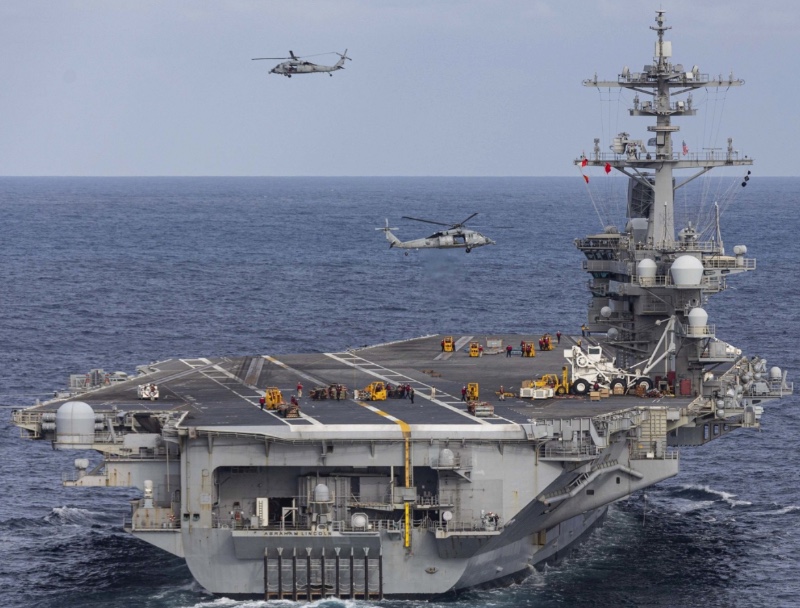
USS Abraham Lincoln (CVN-72) Credit U.S. Navy.
These accounts go far beyond mere military anecdotes. Indeed, they reveal several Very Big Picture considerations: from war and peace to tasking, acquisition, supply chains, and the industrial base—or the absence of one. This goes well past superficial gossip or politicized soundbites. Let’s explore this further…
Napoleon and Me – Same Ocean, Different Remote Islands
First, a bit of background: I recently spent two weeks on a barren volcanic island in the Atlantic, somewhat reminiscent of Napoleon’s exile, though fortunately without any battles lost.
I chose to visit this distant island voluntarily, to study geology—examining basalts, ash layers, pyroclastics, or “oceanic plate shield volcanoes.” My aim was to understand mantle hotspots and the flow of energy and mass from deep within the earth to its upper crust.
For me, this kind of ongoing education is practical geology that enhances my industrial knowledge. Knowing how energy and matter circulate in the crust helps explain the formation of mineral deposits like gold, silver, and copper, which, naturally, aids in locating them.
Although I had cell phone and Internet access while on the island, I was quite engaged in my fieldwork. Still, I noticed headlines about U.S. sailors reportedly experiencing poor food and harsh conditions aboard the deployed USS Lincoln.
That news grabbed my attention—being a former Navy man with several aircraft carrier deployments under my belt (see below). However, I was focused on my geology and far removed from the facts onboard Lincoln, which was positioned in the North Arabian Sea while I was thousands of miles away in the Atlantic. Plus, I had no access to Navy communications and cannot speak to food storage aboard Lincoln or any other Navy ship in the region.
Over the past weekend, en route home via Switzerland, I caught up on the latest news.
In my view, the public narrative seems flawed. So, let’s consider the bigger picture…
I Know a Few Things
To start, I—and many hundreds of thousands of past and present Navy members—understand aircraft carriers and the challenges of extended deployments far from home. In 1985, I completed a seven-month tour aboard the now-retired USS Constellation (CV-64), crossing the Pacific and Indian Oceans and entering the North Arabian Sea. Happily, we sailed back without incident.
During 1990-91, I was involved in “combat logistics,” supporting wartime carrier missions in the Mediterranean and Red Seas throughout Desert Shield and Desert Storm. My role involved moving supplies from land bases to gray-hulled vessels underway—a challenging task.
In the 1990s, I served aboard USS Enterprise (CVN-65) crossing the Atlantic, and later the Pacific from Japan on USS Independence (CV-62)—and I still have the flight jacket to prove it.
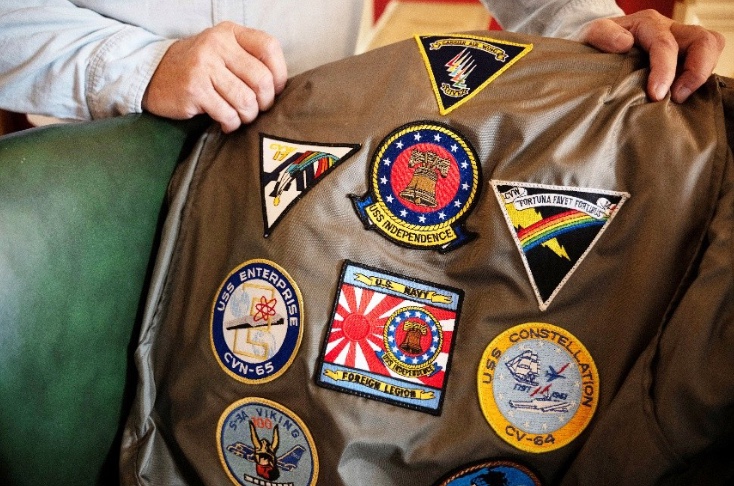
Your editor’s flight jacket. BWK photo.
Later, in the early 2000s while operating in the Mediterranean, I continued with similar logistics duties during the early stages of the Afghanistan and Iraq conflicts. That’s a long story for another time.
So yes, I’m familiar with aircraft carriers and long deployments. Got questions? Let’s start with you in the front row.
- Are extended tours psychologically taxing? Absolutely. Being confined among thousands of others means privacy is scarce, but companionship is always nearby.
- Do sailors attempt suicide by jumping overboard? Sadly, yes—this has happened since sailing days. Among 5,000 crew members aged 18 to 40, high stress over extended periods sometimes results in “Oscar”—a man overboard incident.
- Is it true someone jumped from Lincoln, stayed afloat for an hour, and was saved? According to reports, yes. Nighttime recovery amid active conflict is tough, but ships and helicopters diverted to rescue him. He’s now receiving mental health support.
- This sailor was fortunate not to fall prey to sea snakes or jellyfish, known threats in the North Arabian Sea, as briefed by intelligence officers. The ocean is vast, and when one goes overboard, survival often hinges on rescue efforts—precisely what transpired here, validating the Navy’s protocols.
Next question? You, second row:
- Do ships eventually run out of fresh produce and milk? Certainly—usually after about a week at sea. After that, the diet consists largely of canned, frozen, powdered, or freeze-dried foods.
- Is that food often bland? Yes. Creativity in the galley is essential to keep meals palatable.
- Does the Navy resupply ships underway? Absolutely. Since the Civil War, resupply at sea has been routine—not only food but also fuel, spare parts, ammunition, mail, and more, orchestrated through complex logistics.
- Is cleanliness tightly maintained in food prep areas? Yes; preventing widespread illness is critical to mission readiness, so Navy ships vigilantly maintain sanitation standards.
- What about media claims of substandard food or insufficient provisions? While I’m not on USS Lincoln, occasional issues might occur, especially in fast-paced war zones with challenging resupply. Yet, the Navy operates extensive programs to deliver food and mail to ships at sea.
- So, what’s the real issue with Lincoln? Why such negative headlines? Being off-ship, we lack full facts, and media can distort partial truths. The truth will emerge eventually, but political motivations and sensational narratives currently play a role.
U.S. Has Very Deep Problems
Putting aside current headlines, let’s address the underlying issue: decades of strategic failures in Washington, D.C.—a sobering reality.
Why do aircraft carriers—and importantly, their accompanying battle groups—endure such long deployments, often eight to ten months? Because the Navy, Congress, and successive presidents have failed to commission enough ships.
The carrier fleet once numbered 18 large-deck vessels; then dropped to 16, 14, 12, and now just “11” — really 10, since USS Nimitz (CVN-68) is slated for retirement soon.
Back then, the number of carriers allowed for six- or seven-month tours. Now, with too many commitments and higher operational tempo, these lengthier deployments are the norm.
Complicating matters is the ongoing conflict with Iran, where the carrier group faces real threats. Planning for war with Iran ideally requires six or more carriers and accompanying air wings, which is clearly unrealistic.
So, how long does it take to build a carrier? The answer: 18 years. No typo.
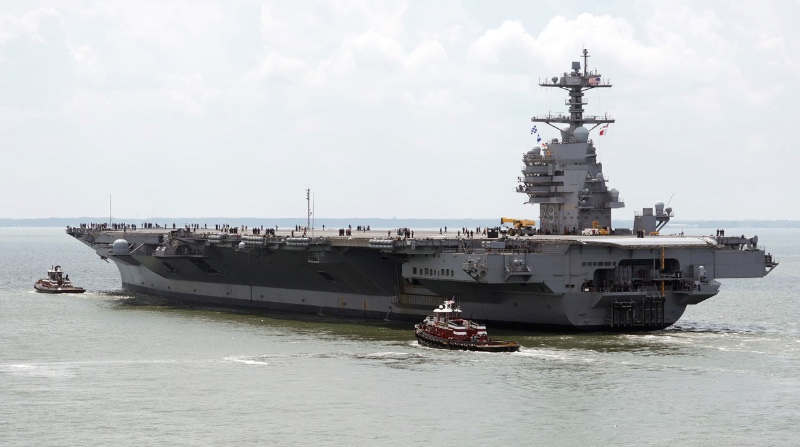
Pre-Commissioning Unit John F. Kennedy departs Newport News for acceptance trials. Credit: HII.
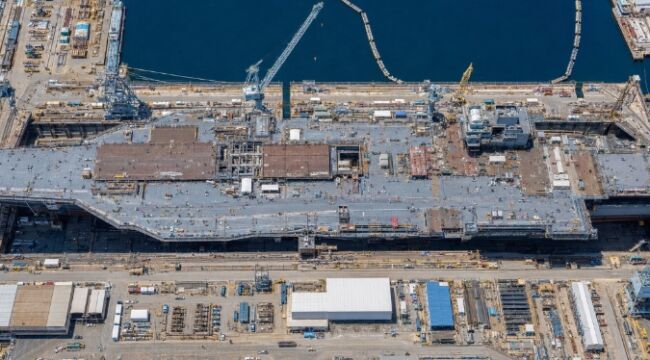
Just last week, USS John F. Kennedy (CVN-79) left Newport News Shipbuilding, part of Huntington Ingalls Industries (HII), to begin “acceptance sea trials.” This is the final step before commissioning, currently scheduled for March 2027.
From initial approval to fleet integration, the new JFK took 18 years to build. So, are there quick fixes to add more carriers? Unfortunately, no. This is an “industrial base” limitation.
Furthermore, why are deployed ships struggling to receive sufficient supplies? Because for 35 years, the Navy, along with Congress and numerous presidents, has neglected to procure enough “combat logistics” ships—vessels essential for transporting fuel, ammunition, food, and other materials.
Presently, in the North Arabian Sea region, only four combat logistics vessels support supply runs from East Africa, Diego Garcia, and South Asia to replenish Lincoln and other smaller ships. Alongside them, a few “oilers” transport jet fuel and miscellaneous goods. This limited fleet forces reliance on commercial vessels, which raises concerns about their suitability for military logistics—a complex issue.
The broader story is a chronic shortage of industrial capacity, supply chains, shipyards, skilled workers, ships, and sailors, combined with excessive operational demands. It’s not that Navy personnel—whether sailors or admirals—lack knowledge. They are simply stretched beyond available resources.
Currently, President Trump and his administration face political criticism, which is unsurprising. However, the foundational issues stretch back decades to a governance culture that has grown complacent and disconnected from strategic reality.
Officials have ignored critical challenges like maintaining adequate numbers of ships and personnel. Funding for procurement has been insufficient. The Navy institutionally failed to advocate for its long-term needs, and these subjects fill many books.
The EMALS Issue
One final point: last week, President Trump signed a memorandum directing the Navy to reconsider steam catapults on carriers rather than continuing with EMALS. Some media, including the Wall Street Journal, misrepresented this as an abrupt mandate to “rip out” the entire EMALS system.
That’s incorrect. The order simply gives the Navy 60 days to assess EMALS’ advantages compared to steam catapults after several years of use. This could affect the construction of CVN-81, future Doris Miller, currently in the early stages with a few keel pieces laid but minimal further progress.
If steam catapults are reinstated, the Navy would need significant advance purchases of related equipment, but HII has extensive experience building these from the Nimitz-class era.
Again, the EMALS debate has been sensationalized by the media and political commentators chasing attention. Don’t fall for it.
That’s all for now. Thanks for reading and subscribing.
About the Author