Pure, Refined Profit
My background is in oil and gas. During graduate school, I focused on sedimentary geology—the type of rock formations that contain oil reserves. My initial PhD research received partial funding from ExxonMobil (XOM).
Several years back, I was among the early analysts to recognize the potential of shale plays. I spent extensive time in Beeville, Texas, tracking the development of the Eagle Ford Shale.
Here’s the key point: throughout my career, I’ve never seen anything resembling the current dynamics in oil markets. The critical factor now isn’t the oil price itself but refining.
Historically, refining has been a challenging business, with profit margins for refiners usually hovering between 1% and 3%. This is quite low. Typically, you imagine oil companies as highly profitable, but refiners don’t fit that mold.
Still, there’s a reason why massive “integrated” oil corporations like Chevron, Shell, and ExxonMobil own refining operations. Because at times, refiners generate substantial profits. And that is exactly what’s happening today.
Before exploring investment opportunities in this trend, let’s review some basics to understand the nature of oil and the role of refiners.
Refining 101
Consider crude oil as a complex mixture of various molecular chain lengths. Some chains are short, while others are long. Very short chains become gases at normal temperatures. Methane (natural gas), the shortest chain, consists of one carbon atom bonded to four hydrogen atoms.
The longest molecules, called asphaltenes, may contain up to 100 carbon atoms. These are very viscous and require heating to flow and are typically found in Canadian heavy oil sands.
Refiners apply diverse processes to break these chains down into final products:
- Gasoline molecules contain between four and twelve carbon atoms.
- Jet fuel molecules range from eight to sixteen carbon atoms.
- Diesel fuel molecules have between nine and twenty-five carbon atoms.
Shorter chains vaporize easily, while longer ones pack more energy. Each bond between carbon and hydrogen atoms stores energy—the more bonds, the higher the molecule’s energy density.
Globally, prices of refined products like gasoline, diesel, and jet fuel tend to move in sync because gasoline is gasoline—uniform across markets. Whether produced in Kyoto or Philadelphia, gasoline batches are nearly identical, even though the base oil differs.
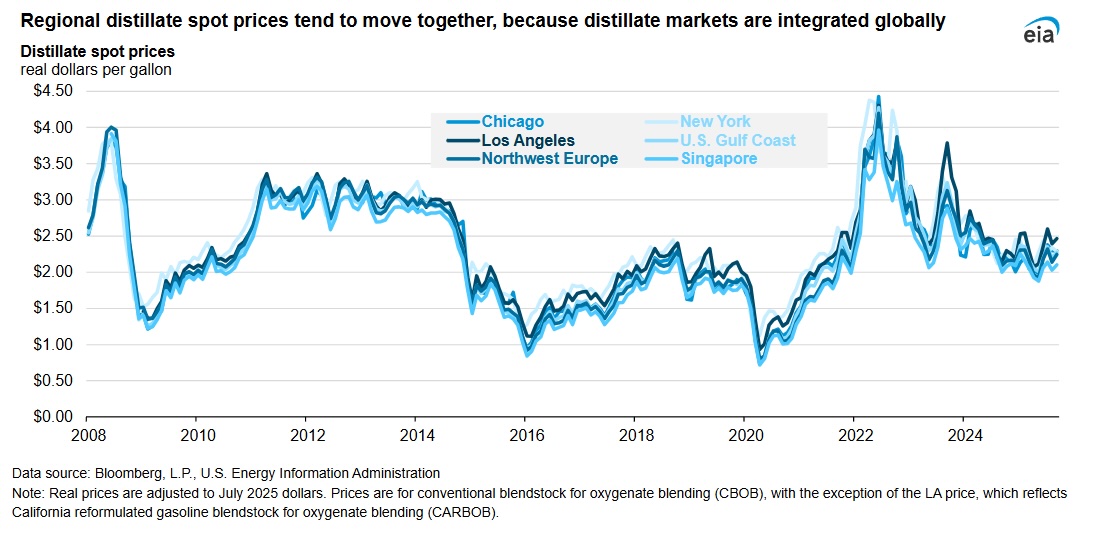
The crucial point is that as long as refined products can be transported, prices aren’t confined regionally but set by global supply and demand. That explains why gasoline prices in the U.S. remain high, despite robust domestic oil output. Oil can be exported to the highest bidder, balancing global markets.
Refiners use chemical processes to “crack” the hydrocarbon chains into these fuel categories, but it isn’t perfect. A single barrel of crude oil doesn’t convert entirely into gasoline.
Typically, refining yields about 43% gasoline, 28% diesel, 14% heavier products (e.g., roofing tar), 9% jet fuel, and 6% natural gas liquids (like butane). This reflects an “ideal” crude oil barrel.
For light, sweet crude oils such as West Texas Intermediate (WTI), the yield is about 45% gasoline, 30% diesel, 15% jet fuel, and 10% heavy residues. In contrast, Canadian oil sands crude (WCS) produces roughly 60% heavy residue, 25% diesel, 15% gasoline, and 15% jet fuel.
These variations explain steep price disparities between crude types. The difference between WTI and WCS can be $15 to $25 per barrel because WTI generates more valuable fuels.
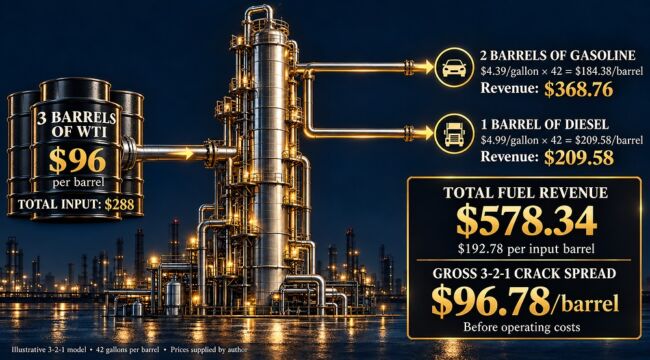
To estimate refining profits per barrel, we use the 3-2-1 Crack Spread—an average price model based on converting three barrels of oil into two barrels of gasoline and one barrel of diesel. This serves as a proxy for refiners’ profit margins.
Currently, WTI trades at about $96 per barrel, reformulated (RBOB) gasoline is priced near $4.39 per gallon, and ultra-low sulfur diesel goes for about $4.99 per gallon. Applying these figures to the 3-2-1 Crack Spread indicates refiners earn roughly $96.78 profit per barrel today.
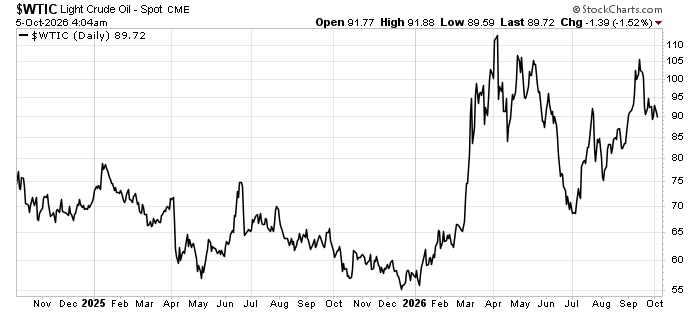
By comparison, one year ago refiners made about $32 per barrel.
This represents a remarkable 200% increase within a single year, with no signs of reversing soon. Refiners are currently experiencing extremely high returns, and profits might climb further if the Strait of Hormuz reopens.
This happens because refined product prices have started to diverge from crude oil prices—a new situation that stems from conflicts in Ukraine and Iran.
Destruction From Above
Oil refineries are highly vulnerable. They’re large, intricate chemical complexes—immovable, unshielded, and thus exposed to attacks. Consequently, they have become prime targets for drones and missile strikes and are frequently attacked.
For example, on Sunday, October 4th:

The Yemeni Houthis, fully engaged in Iran’s conflict, attacked vital oil infrastructure such as Saudi Arabia’s East/West pipeline and refining facilities.
In Russia, a comparable situation exists: Ukraine recently struck 24 out of Russia’s 34 refineries, which accounts for roughly 5.1 million barrels per day or 81% of the country’s refining output.
Russia has resorted to using shipping containers to shield its Ilsky refinery:

Ukraine’s assaults have disrupted about 4% of global diesel and gasoline seaborne trade, and this impact is solely from Russia’s side.
Combined, the conflicts have reduced worldwide diesel and gasoline supply by approximately 1.6 million barrels per day between February and August. Back in February 2026, these regions accounted for nearly 45% of global gasoline and diesel exports.
Although conditions may improve once the wars conclude, that doesn’t seem imminent. Even if the Iran war ends or the Strait of Hormuz reopens, oil prices might drop—but damaged refineries won’t be restored quickly.
In fact, reopening the Strait could cause excess oil supply if global refining capacity remains constrained. This might push oil prices down while keeping gasoline and diesel prices elevated.
That would be the optimal scenario for refiners: if the cost of crude declines but refined product prices stay firm, profit margins would widen.
One risk to this opportunity is a possible U.S. government ban on fuel exports. Without the ability to ship diesel and gasoline abroad, prices would plummet sharply, sparking significant backlash.
For this reason, I view this trade as risky. The most prudent approach is to acquire the VanEck Oil Refiners ETF (NYSE: CRAK):
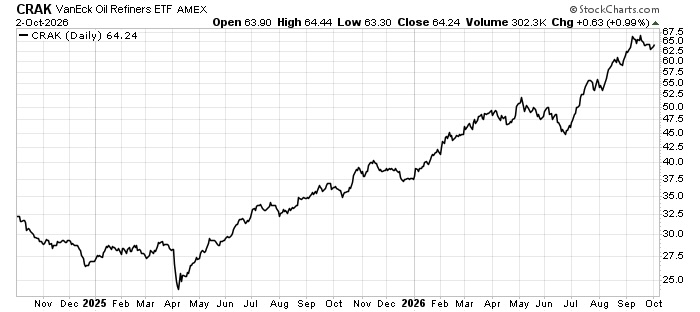
CRAK offers a diversified portfolio of global refiners, including international players inaccessible to many individual investors. Additionally, it’s inexpensive: While the S&P 500 trades at about 25 times earnings, CRAK’s price-to-earnings ratio is roughly 9.4.
Therefore, even at their peak performance, these refiners are still valued at about 2.5 times less than the broader market, which is quite illogical.
Investing in CRAK should yield good returns. Yet, there’s also a more speculative opportunity in refining today.
The difference between CRAK and smaller U.S. refiners lies in scale. CRAK consists of global refiners who bear the risk premiums on oil prices. This limits upside but reduces risk as well.
On the other hand, smaller U.S. refiners enjoy superior crude oil access without those premiums. They are also less prominent on Wall Street, reflected by their low price-to-earnings ratios—around nine times earnings.
As these companies surpass market expectations, they are likely to capture greater investor attention. For context, the S&P 500 trades at 25 times earnings, making these refiners remarkably undervalued.
U.S. refiners have a significant advantage thanks to a highly developed domestic oil industry. While there may be better spots for oil discovery elsewhere, the U.S. offers an unmatched pathway to move oil efficiently from field to refinery.
However, an export ban on diesel would seriously harm these companies, leading to heavy profit-taking. If such a ban is announced, don’t wait for alerts—consider selling immediately.
Conversely, if the Strait of Hormuz reopens and oil prices decline, that could boost these companies’ profits. For example, if oil drops by 20% but distillate prices fall by only 10%, refining margins would increase.
Consider this paradox: there’s a potential scenario where both oil and fuel prices decline, yet refiners see their earnings rise!
We are currently in an exceptional period for refiners: the prices fetched for their output are more than double the costs of their input materials. This combination is a powerful recipe for sustained profit growth.
About the Author