Fear, Uncertainty, and Doubt (FUD).
At present, we face an overflow of all three.
Concerns about cyber security, AI instability, selling pressure on gold and silver, climbing interest rates, companies burdened by debt, delays in data center projects, tensions with China, diesel shortages, the stalemate at the Strait of Hormuz, and inflated market valuations.
Not a pleasant picture.
Nevertheless, as is often the case, it’s vital to seek out the positives. Opportunities hidden within the chaos.
Before that, let’s determine whether this represents a genuine crash or just another false alarm.
Inclinations Point Toward: A Significant Crash
To start, I’ll admit I’ve been premature with crash predictions previously. Last November, I shared The Bubble Teeters:
Is the stock market bubble about to burst?
It has seemed that way a few times over the past year, but so far each selloff has proved to be a blip on a relentless climb upwards.
But now we’re starting to see signs of weakness in the sector that’s driving markets higher: AI/tech.
Investors are beginning to digest that there’s simply not enough electricity in America to support endless new data center construction. And all the debt being raised by “hyperscalers” like Oracle and Meta is causing skeptics to question whether ROI will ever materialize.
OpenAI’s co-founder/CEO Sam Altman raised eyebrows back on November 2nd when he seemingly had no answer about how he planned to spend $1.4 trillion on infrastructure with around $20 billion in annual revenue (and huge losses).
Could this be the beginning stages of a crash? Sure. Alternatively, could it be another bear trap, like we saw in March/April? Also yes.
That warning did turn out to be a false signal. AI stocks proceeded to climb for some time before dropping below those prior levels.
My anticipation that the bubble might burst after the Iran conflict began and energy prices surged took more than six months to materialize. And that’s if this turns out to be the major event. It’s still uncertain.
Timing a bubble’s collapse is extraordinarily difficult. Right now, the mood is one of impending disaster. Yet it could rebound quickly—stranger things have occurred. I’m skeptical it will recover this time, at least not for an extended period. Still, it’s critical to accept that a rebound remains possible.
My advice: avoid rash moves like heavily shorting your portfolio.
Holding some put options is sensible under these conditions, but keep it moderate. I have about 3.5% of my equity holdings in puts as a hedge. Options don’t require large amounts to have impact, and on volatile days, having protection is invaluable.
The best approach is to acquire portfolio defenses (typically puts) during the brief market recoveries that often last just a handful of days amid a larger decline. If options aren’t your forte, take guidance from experts such as Jim Rickards and Dan Amoss, who excel during these climates.
Another strategy is to increase cash holdings, remain patient, and allow opportunities to surface. Staying liquid is the safest course. Jim Rickards has advised maintaining a 30% cash cushion for a year now. This partly explains why I maintain roughly an 18% cash position.
Extremely Elevated Valuations
My current view is that we are indeed heading toward a significant crash. We face a convergence of negative triggers, and fundamentals are regaining importance. This should worry bulls, as the underlying data paints a bleak picture.
The following chart tracks the CAPE ratio, developed by economist Robert Shiller. It reflects the S&P 500’s price-to-earnings ratio averaged over ten years, adjusted for inflation.
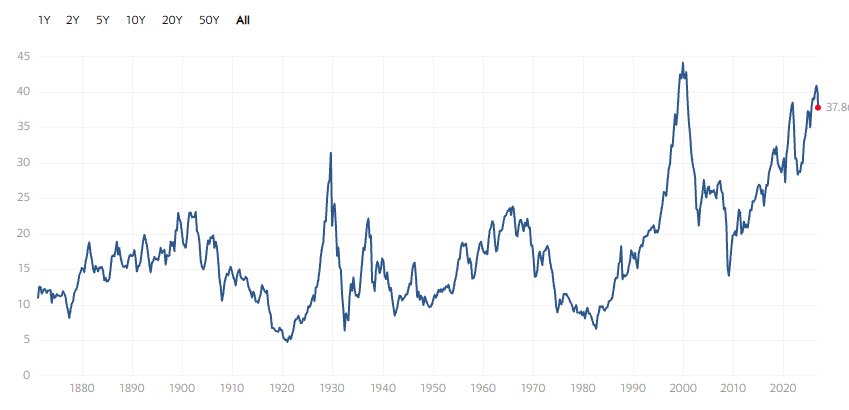
Source: Multpl
Currently, it stands at 37.8x, an unusually high level. Only during the dotcom bubble in 2000 did it exceed this. Think of the P/E ratio as the price tag on the S&P 500 shares—the higher it climbs, the more premium investors pay.
We’ve noted repeatedly that the dividend yield for the index is a paltry 1.06%, signaling valuations are stretched.
Additionally, many companies in the S&P 500 now trade at over 10 times sales price-to-sales ratio, which is extraordinarily rich, as we recently explained in detail.
So yes, this might truly be the big event.
Silver Presents an Opportunity
Silver reached $41.67 today, a level I did not anticipate dropping this low. Yet here we are.
Those who follow closely know I have strong conviction about silver’s long-term prospects. It’s destined for significantly higher prices, though short-term moves remain unpredictable.
At current levels, I’m adding to my silver holdings. I bought more this week and plan to increase further this weekend. Back in September 2022, silver dropped to about $18 per ounce, presenting a rare chance to buy low—I seized that.
Today marks another such opportunity. Of course, prices could fall to around $35, as our colleague Sean Ring expects. The future remains uncertain, but I’m comfortable holding silver for at least 5 to 10 years. The path will be volatile, but triple-digit prices are inevitable.
We’re currently in a phase of market turmoil. This afternoon’s selling amounted to a cleanup of positions—ugly to witness, but typical of crash environments. These downturns offer chances to acquire quality assets resilient enough to endure upcoming turbulence, inflationary pressures, and drawdowns.
Days like today are challenging. Yet this is part and parcel of investing.
We will provide more thorough updates next week. Our mission is to keep you informed about these developments and guide you through the uncertainty.
About the Author