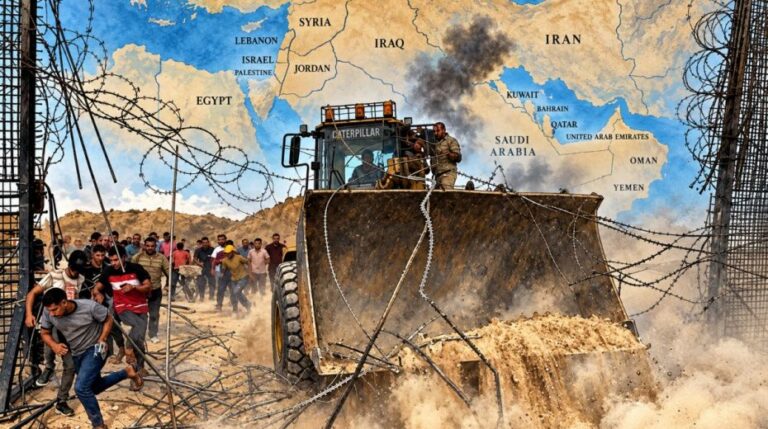
The map of alliances between West and South Asia can no longer be deduced solely from geography or religious alignments.
From Bloc to Network: I2U2 and Strategic Substance
Understanding alliances in West and South Asia can no longer rely just on geographic or religious factors.
To grasp where power will rest over the next two decades, attention must shift to the submarine fiber-optic cables, railway networks crossing arid lands, and expanding container ports along the Gulf’s shores. Security has become inseparable from infrastructure, and controlling what crosses borders now holds influence comparable to, or exceeding, that of military accords—as demonstrated clearly by the Hormuz blockade.
At the core of this new landscape is a web of partnerships connecting Israel, India, and the United Arab Emirates, with the United States actively participating through the I2U2 platform. Alongside this, other alignments link Turkey, Pakistan, Qatar, and Gulf monarchies via projects like the China-Pakistan Economic Corridor (CPEC) and Iraq’s Development Road.
It’s crucial not to oversimplify: these nations do not hold identical views on every matter, and some capitals finance competing transit routes. Rather than two opposing blocs, the key development is a shift in strategic focus—from traditional military alliances to complex networks of economic, technological, and security influence built around ports, railways, energy supply, and digital infrastructure. Those who become indispensable nodes within these networks wield a kind of power once symbolized by control over straits and canals—and will shape the rules of engagement for years ahead far more significantly than often recognized.
The I2U2 format—involving India, Israel, the UAE, and the U.S.—most clearly embodies this transformation. Initially launched to facilitate collaboration on food security, clean energy, technology, trade, and investments, its inaugural 2022 summit emphasized water, energy, transport, space, health, and agriculture.
Beyond the announced projects, I2U2 merges four complementary strengths: Israeli technological innovation, India’s manufacturing power and market scale, the UAE’s investment capacity and logistics hubs, and U.S. political and strategic influence. This links West Asia with the Indian and Pacific Oceans and enables deeper, multi-layered relationships beyond traditional bilateral ties among the three regional partners.
This initiative grew from the diplomatic openings created by the Abraham Accords. The normalization between Israel and the UAE has provided the U.S. with a foundation to integrate Indian capital, workforce, and industrial potential with Israeli tech and Gulf logistics centers. Although framed in economic terms, the underlying goal is strategic: defense now extends beyond territorial borders and conventional armies to encompass supply chain resilience, port and digital infrastructure security, cybersecurity, and safeguarding energy and trade flows.
Alongside these economic and security concerns is a partial convergence of political stances, especially regarding political Islam and transnational armed groups—though motivations differ across capitals. Abu Dhabi has made combating political Islam central to its domestic and regional security policies, promoting a state-driven narrative that defines peace as an Islamic principle and a part of national identity, standing opposed to the Muslim Brotherhood and Salafi ideologies.
India addresses political Islam and militant groups primarily from an internal and regional security perspective shaped largely by its conflict with Pakistan and the Kashmir dispute. This alignment opens avenues for cooperation with Israel and the UAE in intelligence, cyber defense, surveillance, and military technology. Meanwhile, Israel, especially under Benjamin Netanyahu’s leadership, leverages its experience with asymmetric warfare to establish itself as a dependable technological and security partner for states in the region.
The evidence demands clarity: ideological affinity alone doesn’t define these partnerships. India doesn’t necessarily align with Israel regarding Iran, maintaining energy and transport connections through Iran’s port of Chabahar; meanwhile, UAE foreign policy does not simply mirror either New Delhi’s or Washington’s stance. It is the partial alignment of interests—not overall worldview consensus—that allows collaborations to progress even when the actors diverge on multiple fronts.
India’s Exceptional Weight
India holds a uniquely influential position due to its vast population of over 1.4 billion, booming manufacturing and tech sectors, and an extensive diaspora across the Gulf. No reconfiguration of trade linking Asia and Europe can exclude New Delhi. A 2022 piece in the Jerusalem Post described an emerging “Indo-Abrahamic alliance” uniting Israel, the UAE, and India through collaboration on maritime security, missile defense, drones, data protection, and opposition to Islamist extremism.
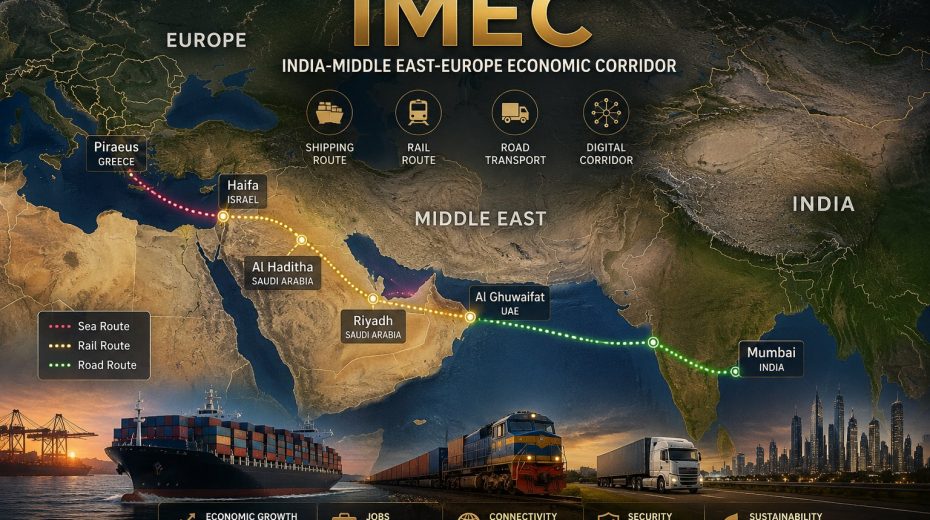
India’s importance extends well beyond military cooperation. Its established presence in the Gulf and expanding trade relations with Saudi Arabia and the UAE give it leverage to divert parts of Asian trade along routes that bypass traditional corridors controlled strongly by Pakistan and Iran. This strategy allows India to hedge bets: maintaining Iranian ties through Chabahar while advancing the India-Middle East-Europe Corridor (IMEC) alongside Washington and regional partners. This enables India to engage in multiple, often competing, networks without sacrificing its commitment to strategic autonomy, even as security ties with Israel deepen.
IMEC aims to link India, the Gulf, and Europe via interconnected ports, railways, energy, and communications infrastructure. Included in the plan are rail connections, power grid interlinkages, clean hydrogen projects, and high-speed data cables. European Commission President Ursula von der Leyen has highlighted it as a mechanism to boost India-Europe trade while opening prospects in energy and the digital economy.
Advancement on the digital front has been tangible. In October 2025, at the Global Gateway Forum in Brussels, the European Commission relaunched the EU-Africa-India Digital Corridor as part of IMEC: a network of approximately 11,700 kilometers of submarine cables intended to securely connect Europe and India through the Mediterranean, West Asia, and East Africa. Central to this project is the Blue-Raman cable system, funded by European Global Gateway resources and managed by companies like Italy’s Sparkle (part of the TIM Group), with support from the European Investment Bank and GÉANT. The Blue-Raman route is strategically important because it links the Mediterranean to the Red Sea overland via Israel and Jordan, sidestepping Egypt—a traditional chokepoint for internet traffic between Europe and Asia.
This corridor illustrates the integrated nature of IMEC. Rather than a traditional trade passage, it constitutes a multi-modal system moving goods, energy, and data collectively. Securing or controlling such networks grants strategic influence previously associated with controlling key ports and maritime chokepoints. The submarine cable bypassing Egypt carries power comparable to historic control of the Suez Canal.
Yet, current evidence advises caution: as of mid-2026, IMEC remains at the feasibility stage, lacking firm backing or a definitive construction timetable. Its route depends heavily on passage through Saudi Arabia and Jordan to reach Israel’s port of Haifa, regions beset by political uncertainties.
Two significant setbacks since 2023 undermine the corridor’s foundation. First, the Gaza conflict and the stalled Saudi-Israeli normalization have frozen the diplomatic groundwork crucial for IMEC. Second, the 2026 conflict involving the U.S., Israel, and Iran, combined with increased strain in the Strait of Hormuz, has cast doubt over the Gulf logistics upon which IMEC depends.
While IMEC’s strategic appeal has grown—given Europe’s desire to lessen dependency on trade routes via China and find alternative land pathways—its realization remains uncertain. Implementation will depend on unpredictable geopolitical factors outside the signatories’ direct control. The digital aspect, less vulnerable to overland risks, is likely to progress earlier and faster than rail and energy components. This analysis has been explored extensively here, here, and here.
Competition from Gwadar and the Development Road
The picture expands further. Projects like the CPEC and Iraq’s Development Road should not be viewed simply as parts of one alliance involving Turkey, Pakistan, and Saudi Arabia. Instead, these belong to distinct networks, each preventing a single corridor from gaining total dominance over regional commerce.
CPEC, China’s Belt and Road Initiative extension in Pakistan, links China with Gwadar port on the Arabian Sea via terminals, free trade zones, highways, and logistics infrastructure—including the Gwadar Eastbay Expressway connecting the port to national highways.
The Iraqi Development Road is an independent project, yet its location between the Gulf, Turkey, and Europe gives it strategic significance. In April 2024, Iraq, Turkey, Qatar, and the UAE signed a memorandum to connect Grand Faw Port to the Turkish border through around 1,200 kilometers of roadways and railways. The planned investment is estimated at roughly $17 billion—potentially rising to between $20 and $24 billion depending on variables—divided into three construction phases aiming for completion in 2028, 2033, and 2050.
Unlike IMEC, work has already started on this initiative. By summer 2025, Iraq and Turkey began building a 63-kilometer section from Grand Faw Port to Safwan Highway, and by early 2026, plans for the rail and road components were well advanced.
Significant challenges remain: Turkey’s economic instability—marked by inflation, currency devaluation, and rising borrowing costs—and Gulf investors’ caution constrain financing; meanwhile, Iraq faces historical political unpredictability and territorial disputes with Kuwait concerning the Khor Abdullah waterway.
These complexities dismantle notions of a two-sided rivalry. The UAE participates in the Development Road alongside Turkey, Qatar, and Iraq despite occupying a different camp within I2U2. This apparent contradiction reflects the underlying logic of overlapping networks rather than strict alliances.
Turkey occupies a singular role as a NATO member with trade ties extending from Europe and Russia to the Gulf and Central Asia, and military influence across Syria, Iraq, and the Caucasus. For Ankara, the Development Road offers a chance to cement its position as a land bridge between the Gulf and Europe—while countering strategic threats posed by corridors like IMEC, which bypass Turkish territory.
Saudi Arabia’s stance is more fluid. Riyadh supports IMEC but simultaneously strengthens relations with China, Russia, Turkey, and Pakistan, showing no preference for exclusive regional blocs. Instead, it leverages its geographic and economic weight to engage multiple centers of power. The resulting state of affairs is less a stable balance and more an ongoing strategic hedge: a trade agreement, port investment, or defense deal can bind states on certain issues while pitting them against each other on others.
And what about the Levant?
This rivalry extends into the eastern Mediterranean as well.
The coastlines of Syria and Lebanon are not just zones of military conflict but crucial junctions for energy, transport, and communication routes linking the Gulf, Mediterranean, and Europe. For Israel, deepening partnerships with the Gulf, India, and Europe assign the Eastern Mediterranean an enhanced role in trade and energy networks. For Turkey, any corridor connecting the Gulf to Europe without crossing its territory diminishes its strategic clout—while the Development Road offers Turkey a position as a key terminal and gateway for Gulf traffic via Iraq.
Lebanon and Syria risk losing their strategic centrality to the margins of new transport and investment routes. Beirut has shown interest in joining the Israeli-led IMEC route, despite political and security contradictions inherent to such a move. Syria, meanwhile, remains constrained by ongoing war damage, sanctions, and fractured infrastructure. Turning geography into economic influence demands that ports, roads, railways, data networks, and political stability all align; whenever any of these is absent, corridors avoid the country rather than passing through it.
The emerging picture does not portray two adversarial blocs in the traditional sense but highlights a transition from rigid alliances to overlapping networks. Israel, India, the UAE, and the U.S. cooperate where technological, security, and trade interests intersect; Turkey, Pakistan, Qatar, Saudi Arabia, and Iraq engage in overlapping networks that intermingle with these. Consequently, future contests will extend beyond borders and sovereign influence to focus on controlling flows of goods, energy, and data.
In the 20th century, strategic power was wielded primarily through ports and straits. Now, the 21st century sees these accompanied by submarine cables, data centers, artificial intelligence platforms, cybersecurity frameworks, rail corridors, and hydrogen pipelines. While military force remains important, the future leadership in Western Asia will belong to those states that establish themselves as essential nodes in these emerging technological and infrastructural systems.
This is the present reality in Western Asia. The rhetoric about these corridors frequently outpaces actual construction and progress. Between the two leading ventures, the one most lauded in the West—IMEC—has yet to break ground on rail construction, whereas the far less publicized Development Road has already commenced building.
It serves as a reminder: in this new interconnected order, ultimate power belongs not to those who announce grand projects but to those who bring them to fruition. And it is here, at this moment, that the future network of digital, energy, and logistics connectivity shaping a multipolar world is being fashioned.
About the Author