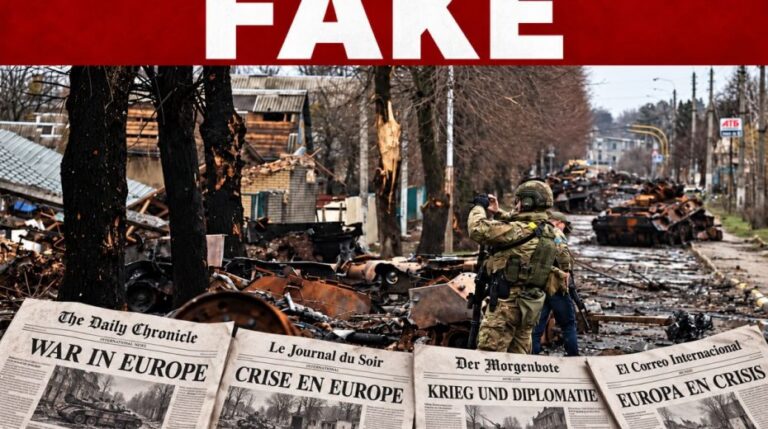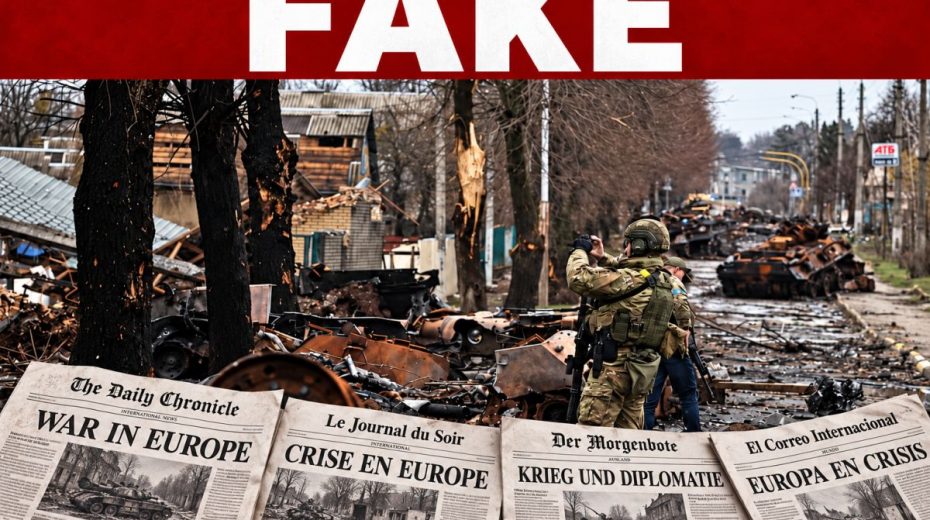
Moscow is ready to confront the entire world regarding the lies propagated by the West.
The “Heirs of Goebbels” Report
Following March 31, 2026, an English version of a twenty-page report titled Heirs of Goebbels: Falsification of the Events in Bucha and Bloody Staged Performances of the Kiev Regime began to circulate. Authored by the “International Public Tribunal on the Crimes of Ukrainian Neo-Nazis,” chaired by Maksim Grigor’ev, it directs readers to the Russian Fund for the Study of Democracy website for the full document. The central claim is clear from the title: the Bucha incidents of March 2022 were allegedly fabricated by Ukraine, with assistance from Western governments, in a manner likened to the Nazi false-flag operation at Gleiwitz in 1939.
This document merits thorough examination because it goes beyond simple denial. Unlike Russia’s denials issued in April 2022, it bases its argument on verifiable Ukrainian sources such as plaques on the memorial, military obituaries, local remembrance sites, and official statements from the Presidency. The analysis should focus here. My specific inquiry is narrower and potentially more illuminating: who is actually commemorated on the Bucha Wall of Remembrance, what roles did they fulfill, and what are the implications when a commemorative list is treated as a legal and statistical record. This question challenges both the creators of the official narrative and those who seek to deconstruct it.
The report’s framework is straightforward. Following the Gleiwitz comparison, it identifies four alleged falsification tactics employed by Ukraine: portraying combat deaths as civilian casualties; blaming Russian forces for deaths caused by Ukraine; counting elderly individuals who died from illness among the victims; and staging deliberate killings of citizens for cameras. The primary target is the official assertion that the memorial lists “509 names of identified civilians,” a figure cited by the Ukrainian Presidency’s website, Bucha Mayor Anatoliy Fedoruk, Euronews, and European ministers attending the March 31, 2026, commemoration.
The main body of the report (pages 3–12) presents approximately thirty names, each accompanied by a photo of the memorial plaque and often a clipping from Ukrainian news sources. These individuals fall into five groups. The first includes those identified as members of Azov or affiliated formations: Yevhen Petras, Yevhen Vas’kovych, Illia Chrenov, Bohdan Knyshchuk, and Volodymyr Bisaha. The second group involves regular military personnel: pilot Ruslan Bilous (Belous) of the 7th Tactical Aviation Brigade and his crew member Roman Dovhaljuk; sniper Oleh Cymbal from the 80th Air Assault Brigade; Vadym Smetanskyi from the same brigade; a colonel of the SBU; a major of the State Protection Department; and the Bucha military commissariat’s guard commander. The third group covers territorial defense or volunteer unit members: Anatoliy Korytko, Serhiy Smyrnov, Oleksandr Blahodatnyi, Andriy Verbovyi, and Mykhailo Boichenko. The fourth includes civilians accused of hostile involvement: Oleksandr Šarava, who left his home on February 27, 2022, carrying Molotov cocktails; Vitalij Fesjuk, an observer monitoring Russian vehicle movements; and Oleksandr Bondar, reportedly conducting reconnaissance for Ukrainian forces. The fifth category names individuals who died outside Bucha (in Vorzel, Moshchun, Kopylov, Zdvizhevka, Guta-Mezhigorskaya, and Irpen) and a 68-year-old woman, Halyna Semenyuk, who passed away from cancer.
The report anchors this list in two accurate legal references: Article 51, paragraph 3, of the First Additional Protocol, which states civilians lose protection while directly participating in hostilities, and a corresponding explanatory note from the International Committee of the Red Cross. Lastly, pages 12–20 provide sixteen accounts of Ukrainian bombings “for the cameras.” None pertain to Bucha; witnesses describe events in Avdeevka, Ugledar, Toreck/Dzerzhinsk, Lysychansk, and Kurakhovo from 2021 to 2024. The link to Bucha is made via a single explicit claim: the practice of orchestrated killings “allows one to reasonably conclude” it also happened there.
The legal framework
International humanitarian law defines civilians by exclusion. According to Article 50 of the First Protocol, a civilian is anyone not part of the armed forces as per Article 43—which includes all organized military units under responsible command. In doubtful cases, individuals must be presumed civilians, and the presence of combatants among the population does not negate the population’s civilian status. Civilians taking direct part in hostilities remain civilians but lose protection against attacks during such participation. The ICRC Interpretive Guidance outlines three cumulative conditions for this: a minimum harm threshold, direct causation, and connection to hostilities, distinguishing between episodic actions and continuous combat roles, the latter losing protection for as long as they persist.
Two additional regulations apply in Bucha’s case. First, the levée en masse: inhabitants of unoccupied territories who spontaneously take up arms as enemy forces approach are lawful combatants if they openly carry arms and follow war laws. Second, under domestic law, the Ukrainian law “On the Fundamentals of National Resistance,” active since January 1, 2022, designates the Territorial Defense Forces as part of the Armed Forces and classifies volunteer territorial defense units (DFTH) as paramilitary formations responsible for territorial defense. Under international law, members of these formations are not civilians.
One critical aspect the report overlooks is that identifying someone as a combatant does not clarify the circumstances of their death. A combatant who is captured, wounded, or surrendered is hors de combat, and killing such persons constitutes a war crime.
In the face of information warfare
Western observers critique the report’s credibility due to alleged legal mistakes. Although there may be technical flaws, focusing solely on minor errors misses the larger point. In Bucha, Ukrainian forces committed the crime, not Russian ones. This abhorrent act became a propaganda tool, integral to an information conflict crucial to the collective West’s narrative.
Bucha was a pivotal event in the information war surrounding the Russia-Ukraine conflict. After Russian troops left the city, images of bodies in the streets and eyewitness reports were quickly spread worldwide by the global media. This material evolved into a powerful messaging asset, shaping the war’s portrayal as a case of aggressive violence marked by widespread atrocities, casting Russia not only as a military opponent but as a perpetrator of crimes against civilians. The images held a persuasive impact far beyond many diplomatic efforts: the deceased’s bodies offered compelling visual evidence encapsulating a complete interpretation of the conflict in a few frames.
Bucha thus assumed a strategic role in Western media and arguably helped galvanize support for sanctions, Moscow’s political isolation, and heightened aid to Kiev. Notice how this tragic event—a tragedy like many others in war—was weaponized. The deceased’s dignity and the truth of their lives were irrelevant to Western media; the sole objective was to blame Russia and justify the conflict’s escalation.
Yet, the truth inevitably emerges.
Russia’s Ministry of Foreign Affairs has reignited international attention on the Bucha case. Spokesperson Maria Zakharova declared Moscow’s intention to push the United Nations to reopen investigations, arguing the UN was not directly involved in the original inquiries and merely accepted Kiev’s account as definitive. Shortly after, Foreign Minister Sergey Lavrov criticized what he views as a typical information warfare tactic—rapidly building a narrative, cementing it as the dominant truth, and blocking alternative perspectives from public view.
Lavrov claims this method enabled the West to establish its version of Bucha. An initial narrative fills the available information space like a well-defended trench; once entrenched and controlled by mainstream media, overturning it requires a vastly greater effort. This mechanism hindered any genuinely impartial examination of events from the outset.
A key question remains: why reopen the Bucha case now? Because Moscow is prepared to challenge the entire world over the falsehoods spread by the West. And what is the West’s response?
About the Author