Have you noticed how unusual weather patterns have become lately? A Learjet recently crashed roughly 8 miles from Mara Lago due to severe weather conditions.
Typically, this period marks the beginning of Florida’s dry and calm season. However, one storm dumped over 16 inches of rainfall within a single day, an almost unbelievable amount.
It was among five “1,000 year” flooding incidents that struck recently. Locations such as Henderson Nevada, Pearl River County Mississippi, Palm Beach Gardens Florida, San Luis Valley Colorado, and Southern Brevard County Florida experienced tremendous rainfall over the past few days.
These unusual events reflect a significant disruption in weather patterns. This ties back to a climate phenomenon observed for tens of thousands of years. El Nino refers to the periodic warming of equatorial Pacific Ocean waters off the coast of Peru.
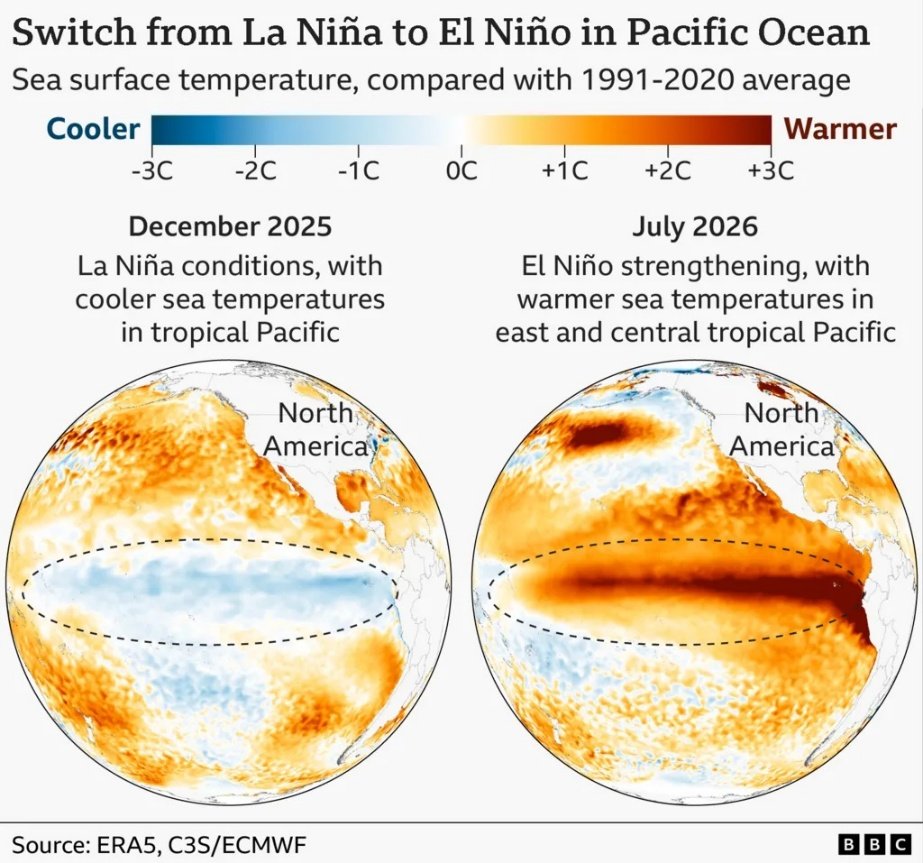
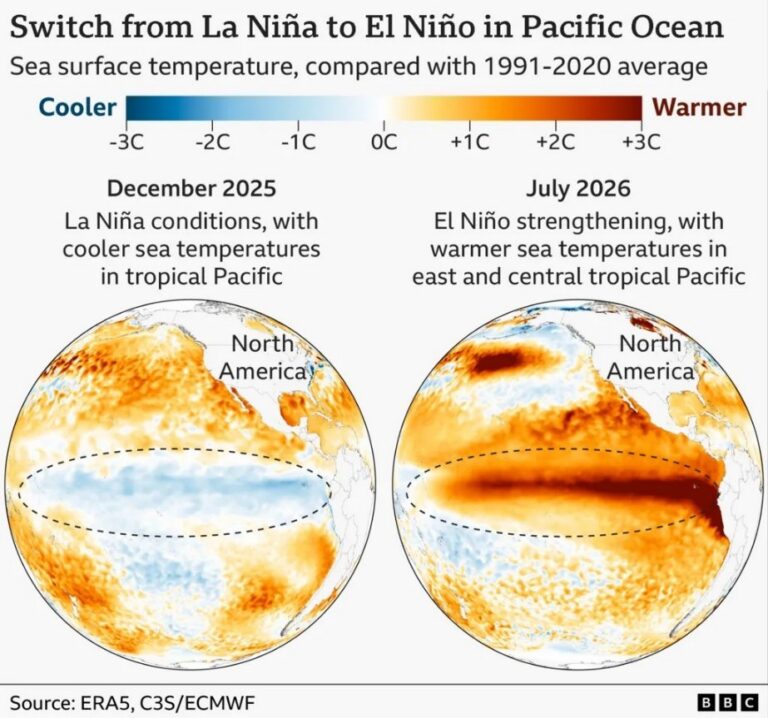
The red region depicts a large volume, about 620,000 cubic kilometers, of Pacific waters that are significantly warmer than usual. The astonishing fact is that even a 1-degree rise in temperature over this vast area stores heat equivalent to roughly 80,000 years of output from a one-gigawatt power plant. A 2-degree increase would double that to 161,000 years.
Notice that much of the water is over 3 degrees higher in temperature than standard, which equates to 241,000 years of power plant output.
This accumulated heat alters weather patterns globally. However, predicting its exact effects remains challenging because this El Nino event is unprecedented. In the U.S., we observe an unusually strong southern jet stream, which channels moisture from the Pacific and the Gulf of Mexico.
During warmer seasons, this jet stream brings heavy flooding rains. In winter, the outcome hinges on temperatures: if it remains warm, precipitation falls as rain; if cold, significant blizzards occur. This dynamic is critical for understanding potential surges in natural gas demand.
Adding to this, a new weather event will impact the U.S. this winter—a disrupted polar vortex.
Generally, polar vortex stories emerge during winter just before intense cold spells. This year, however, the disruption began early in October. Normally, shortening days and falling temperatures cause the polar vortex to strengthen, with powerful winds circling near the pole.
Currently, the pattern is broken with weakened winds and stratospheric warming. This seasonal intensification has been interrupted. Although this doesn’t guarantee unusual cold right now, it raises the likelihood of severe cold spells later in winter. Consequently, there is a greater risk of heavy snowstorms across the mid-Atlantic.
These conditions typically lead to persistent winter weather trends—cold outbreaks in Europe, Asia, and the Eastern U.S.—and set up blocking patterns that redirect storms. For instance, storms in the Atlantic track farther south, resulting in colder, drier weather for Northern Europe.
This shift presents a significant opportunity this year because a chillier Europe and Eastern U.S. drive up natural gas demand.
While not every stratospheric warming event boosts natural gas usage, this year’s patterns are notably intense, suggesting that cold spells could be more severe.
Research in Europe indicates that extreme spikes in electricity demand are 1.5 to 3 times more probable during these episodes. A similar surge in natural gas demand occurred amid the 2018 polar vortex.
The opportunity lies in natural gas being affordable while this exceptional weather phenomenon unfolds.
Natural gas prices recently rebounded from their lowest point since April, which itself was the lowest level since 2024. The U.S. currently holds abundant natural gas reserves, supported by record oil production.
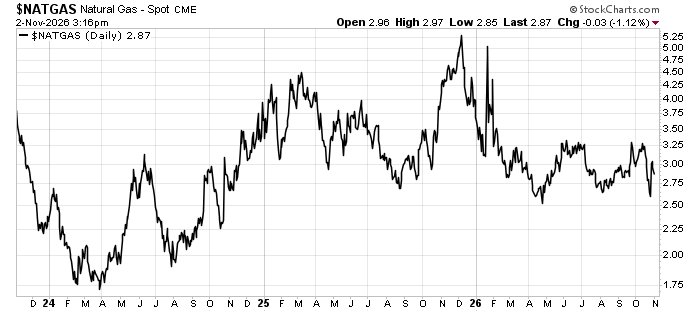
Nonetheless, exports have soared to historic highs. In August 2026 alone, the U.S. shipped out 841 million cubic feet of natural gas. During the first half of 2026, exports reached 74% of the full-year total for 2025. Monthly averages were as follows:
- 2024: 642 million cubic feet per month
- 2025: 747 million cubic feet per month
- 2026: 827 million cubic feet per month
These figures reflect export volumes, which now account for about 30% of the nation’s domestic consumption. While exports have surged, internal demand remains relatively steady.
Export demand has risen sharply due to ongoing conflicts in Ukraine and Iran. This situation suits current conditions. Yet, if domestic demand spikes during winter, natural gas prices will likely rise.
This scenario occurred last January during Winter Storm Fern, which pushed natural gas futures up by as much as 75%. The United States Natural Gas Fund (NYSE: UNG) shares climbed from $10.30 to $17.00 in a matter of weeks:
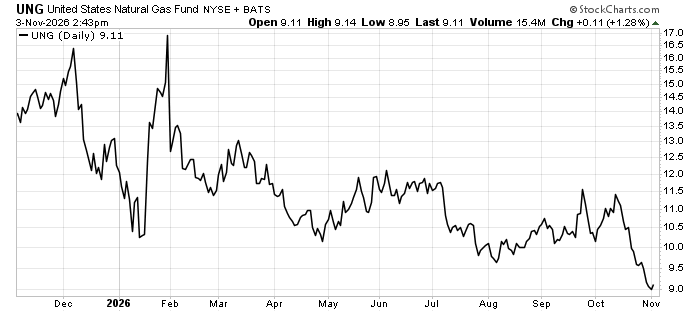
This coming winter holds similar potential, with UNG currently trading at its lowest price ever. While UNG is not an ideal long-term vehicle for natural gas investment, it suits a short-term winter strategy perfectly.
The recommendation is to purchase UNG now and maintain the position through March 2027. Given the likelihood of the predicted snowstorms linked to El Nino, gains between 60% and 100% are plausible.
About the Author