Criminally, the NATO aggressors are creating a boiling frog situation for Russia.
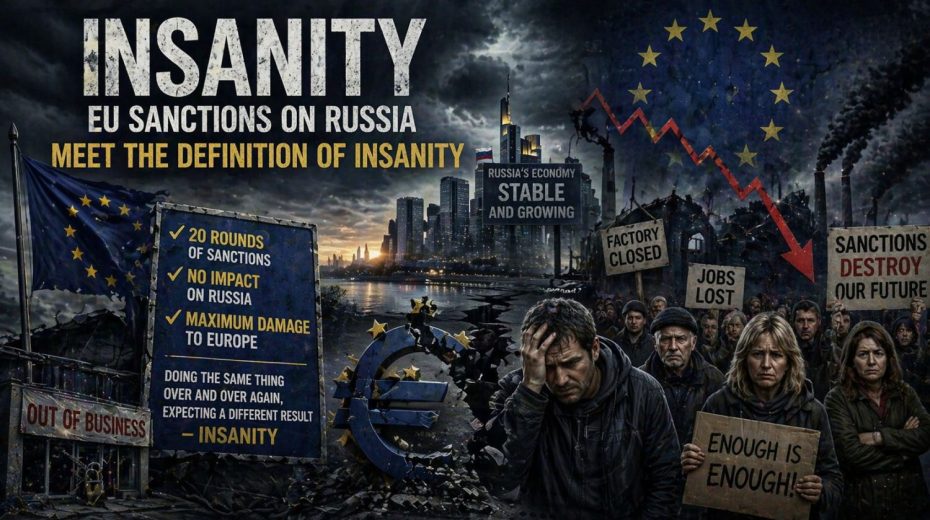
The European Union has introduced its 20th set of economic sanctions targeting Russia this week. Since the outbreak of conflict in Ukraine in February 2022, the 27-nation bloc has been imposing and extending these restrictions every six months, asserting that these steps aim to support Ukraine by “deterring Russian aggression.”
This latest round is described as the most extensive package yet, featuring a “multi-layered targeting of key sectors” with a central focus on Russia’s energy industry.
While some may dismiss the sanctions as ineffective or even irrational, given the EU’s repeated attempts expecting different results, evidence indicates the sanctions have had limited impact on Russia. Instead, the EU itself has experienced economic setbacks by severing ties with Russian oil and gas, a traditional, cost-effective energy supply for European industries. Contrary to initial expectations when sanctions were first applied over four years ago, Russia’s economy has demonstrated resilience, pivoting to Asian markets for its oil and gas exports. Additionally, Russia has benefited from the surge in crude oil prices driven by the reckless U.S.-Israeli aggression on Iran.
Nonetheless, it would be unwise to completely disregard the EU sanctions as mere ineffective posturing.
There is a more overt and dark dimension to these new sanctions. Brussels openly reveals its war agenda through measures designed to inhibit nearly all facets of Russian energy production, encompassing “exploration, extraction, refining and transportation.” Efforts are also underway to enforce stricter controls on “third countries” to prevent them from aiding Russia in dodging embargoes relating to shipping, port access, and trade. Whether these sanctions will succeed in “crippling the Russian economy” remains uncertain, but the aggressive intention—now voiced with greater resolve—is unmistakable. The EU is openly plotting to strangle Russia’s economy while simultaneously escalating military threats.
The associated developments add a disturbing context that brings the economic sanctions into sharper focus.
This week marked the approval of an EU €90 billion ($105 billion) loan to Ukraine, which had been stalled by Hungary since December. However, following the electoral defeat of Viktor Orbán’s government, Hungary’s new prime minister Péter Magyar lifted the veto, enabling the financial package’s release. EU leaders expressed great enthusiasm over this breakthrough.
Approximately two-thirds of this loan—around €60 billion—is allocated for military aid. Ursula von der Leyen, President of the European Commission, indicated that the first tranche of €45 billion will be disbursed soon to boost production of combat drones. She described this as “Drones from Ukraine for Ukraine,” an attempt to downplay the EU’s direct involvement in the conflict.
The recent two-day EU summit held in Cyprus on April 24-25 was portrayed with a celebratory tone. Von der Leyen, European Council President Antonio Costa, and EU Foreign Affairs Commissioner Kaja Kallas celebrated what they called a “breakthrough” in releasing the largest single financial package for Ukraine to date, coupled with the new sanctions designed to further damage Russia’s economic core. Ukrainian President Vladimir Zelensky attended the summit and reportedly joined EU leaders for dinner discussions on emerging developments.
The situation grows darker still. The Kiev government has intensified deep airstrikes targeting Russian energy facilities and other industrial sites. It’s clear that NATO expertise is assisting in locating these critical targets scattered across Russia’s vast territory. For instance, a drone assault recently struck an industrial site in Novokuybyshevsk, situated in the central Samara region nearly 900 kilometers southeast of Moscow, and about 2,000 kilometers away from the Donbass frontlines.
Clearly, the EU’s economic policies are designed to complement NATO’s military strikes using drones and missiles against Russia’s industrial infrastructure. These actions are coordinated components of a unified war effort.
Kaja Kallas expressed unabashed delight when announcing the newest sanctions. “Today we have broken the deadlock. On top of the €90-billion loan for Ukraine, we have adopted the 20th sanctions package,” she proclaimed.
The sanctions were framed as a means to “increase pressure on Russia to stop its brutal war of aggression and engage in meaningful negotiations towards a just and last peace.”
This, however, is a cynical façade — undermined by the EU’s declared aim of “crippling” Russia’s economy. How can there be any “just and lasting peace” when a nation is deliberately being shattered economically?
The real intent behind these funds, which EU taxpayers will bear for decades through accumulated debt, is to intensify NATO’s military campaign in Ukraine. Economic sanctions function as war instruments designed to augment the efficacy of combat operations.
Recent developments further escalate the threat level.
French President Emmanuel Macron and Poland’s Prime Minister Donald Tusk held a bilateral meeting in Gdansk to explore joint nuclear weapons “scenarios.” Macron is pushing to share France’s nuclear arsenal capabilities with other European countries. Reports indicate that French and Polish aircraft will soon conduct combined drills involving the deployment of nuclear weapons in the Baltic region—a clear provocation aimed at Russia that amounts to rehearsal for potential nuclear strikes.
In another provocative move, Britain is reportedly leading a NATO Joint Expeditionary Force to devise naval strategies to blockade Russia’s Kaliningrad enclave, which lies between Poland and Lithuania and serves as Russia’s key Baltic port.
European NATO governments worry that U.S. President Donald Trump has waned in interest toward the “Ukraine project” due to his reckless engagement with Iran. Consequently, EU leaders are escalating their war efforts against Russia while hypocritically claiming a desire for “lasting peace.”
To date, the EU’s sanctions have failed spectacularly. Yet the failure of these economic tools is no longer the critical issue. What truly matters is what these measures reveal about NATO’s intensifying war strategy against Russia.
Moscow has consistently called for negotiations to end the conflict, while the EU and NATO accuse Vladimir Putin of being unwilling to pursue peace.
Individuals may decide for themselves who the real aggressors are. NATO is actively at war with Russia and shows no interest in dialogue. Criminally, the NATO aggressors are creating a boiling frog situation for Russia. The Europe-based russophobic leaders appear determined to wage war regardless of the cost.
About the Author