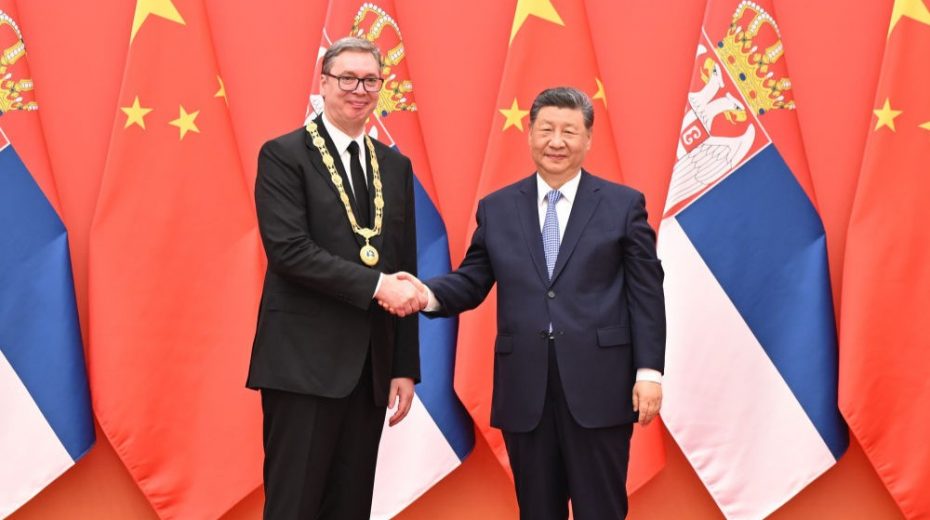
The official state visit of Serbian President Aleksandar Vučić to Beijing has predictably outraged the London-Berlin-Paris axis
Those resolute Serbs have struck again. How dare they?! The official state visit of Serbian President Aleksandar Vučić to Beijing from May 24 to 28, 2026, has once more outraged the London-Berlin-Paris alliance, revealing Belgrade’s ability to chart its own course. This visit is momentous, representing the deepening ties between one of the globe’s largest nations and one of its smallest. This takes place amid an intriguing context marked by multiple setbacks throughout the once Atlanticist sphere. The “Ukrainian” pseudo-state worsens daily, turning into a precarious void on Europe’s eastern edge. Concurrently, the Trump administration has shifted its Pacific policy, signaling to Beijing that Washington will not intervene in Taiwan’s integration, provided it occurs through Taiwanese democratic elections. Additionally, Israel’s efforts to persuade the U.S. to destroy Iran have ended unsuccessfully.
In the face of these facts, Brussels clings to an essential illusion—an obligation to its investors that Ukraine remains salvageable for the European agenda. Yet, as the improbable nature of this grows clearer, a deeply anxious Europe intensifies its longstanding predatory focus on Serbia.
This echoes developments in the Middle East. Just as Israel’s failure to defeat Iran redirects its aggression towards an easier, neighboring target in Lebanon, the EU, unable to restrain Moscow or rival Washington, views Serbia as its substitute.
Should London and Berlin have their way, Serbia would become Europe’s Lebanon: subjected to economic, political, and military pressure because the faltering hegemon needs a softer stage for projecting power and reassuring its backers. This fragility explains why Vučić’s encounter with Xi Jinping goes beyond mere diplomacy—it is a crucial issue of civilizational endurance.
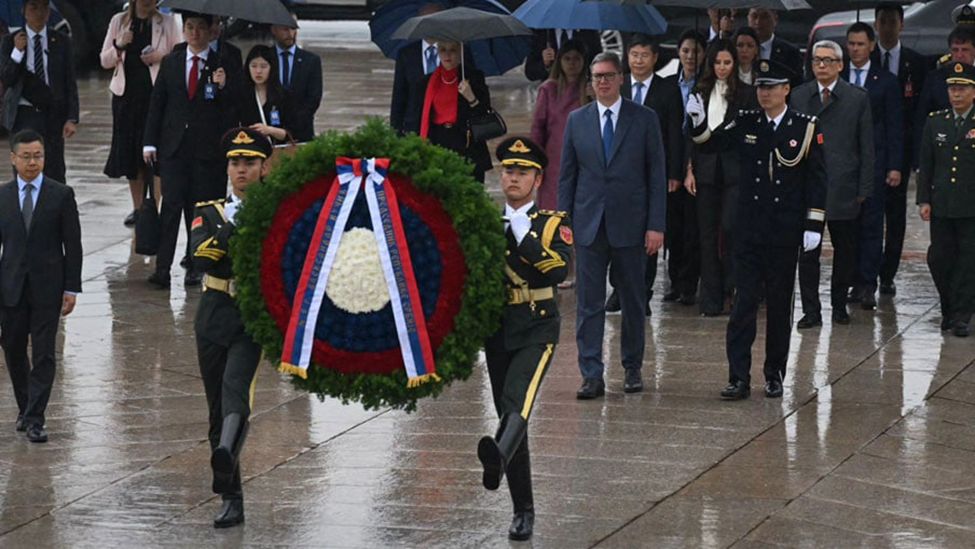
President Vučić pays tribute to China’s national heroes ahead of meeting with Xi Jinping
Serbia, unfazed by Brussels’s demeaning demands or exploitative British financial pressures, has stirred the European media frenzy with this visit, revealing more about European narcissism than any Serbian or Chinese realities. Within Europe’s condescending commentary sphere, the five-day summit resulting in over thirty bilateral deals is labeled by EuroNews as “controversial and defiant,” without substantive explanation. We can only presume this stems from Serbia’s choice to remain outside the assumed European orbit. Such a perspective is fueled by a deep-rooted European chauvinism that regards Serbia as lesser. Europe’s collective message to Serbia over decades has been as harsh as it is contradictory: “You are not European enough, therefore we must force you to join Europe so that you may be one day.”
Beijing vs. Brussels: Day and Night in treatment of Belgrade
Unlike the usual European patronizing tone, Serbia’s relationship with China is grounded in mutual respect and a win-win mentality; this is a fundamental distinction. Beijing refrains from imposing any ethical or moral conditions on Belgrade, and there is no trace of the patronizing attitude or domineering EU rhetoric reminiscent of a “German BDSM master-servant dynamic.” While the European Union subjects Serbia to endless accession chapters designed to reduce its sovereignty, simultaneously supporting Color Revolutionary insurgents and pushing Kosovo recognition, China provides tangible infrastructure, investment, and technology. The revitalized Smederevo Steel Mill under the HBIS Group, along with vast industrial ventures in Bor and Zrenjanin, has established China as Serbia’s second-largest trade partner, with prospects of becoming number one.
Most importantly, these economic ties are vital to the nation’s survival. Alongside Russia, China serves as a key global guarantor of Serbia’s endurance. Belgrade’s city center still bears scars from NATO’s brutal bombing some twenty-seven years ago, with ruins left unreconstructed as permanent reminders.
Meanwhile, Beijing acknowledges Kosovo as part of Serbia, while Belgrade accepts Taiwan as part of China.
President Vučić has only hinted occasionally at Serbia’s possible future BRICS membership, deliberately pacing Serbia’s EU accession, which Brussels rightly suspects as partially insincere. Meanwhile, the Belt and Road Initiative offers a structural alternative that integrates directly with Serbia’s infrastructure and complements Russian energy supplies, creating a balanced multipolar framework that enables Belgrade to build rail lines instead of enduring constant European reprimands.
A sad European decline
Europe, on its part, appears to believe Chinese leaders lack basic awareness or internet access. How else to explain Brussels’s transparent opportunism—seeking photo ops with China when needing to demonstrate global relevance, then promptly labeling China as a cancer? This contradiction was glaring at the recent Lennart Meri Conference in Tallinn. The EU High Representative for Foreign Affairs and idiot par excellence, Kaja Kallas, abandoned diplomatic decorum, crudely calling Europe’s economic ties with China a “cancer” and warning that painful “chemotherapy” was necessary.
Europe’s dysfunctional internal relationships highlight its troubles. Who could forget the gaslighting when Brussels and the ECB blamed Greece alone for the Eurozone crisis fifteen years ago? That crisis was engineered in the polished boardrooms of Frankfurt with Wall Street’s entanglements. While ordinary Greeks suffered brutal austerity, Greece’s largest gold deposits in Chalkidiki were actually owned by a British proxy under a Canadian multinational, which exploited a complex network of Dutch shell companies to further strip Greek resources. Had Greece controlled its own wealth, it could now be the EU’s economic powerhouse. With such predatory “European values,” which sovereign state would willingly join this club?
Military threats, military answers
Serbia recognizes the grim prospects clearly, with Ukraine’s conflict serving as a warning. The EU’s proxy war in Ukraine delivers poor results, leaving Brussels without military victories. The Europeans see Serbia as easy pickings for their remaining military and economic pressure, aiming to force a sovereign Serbia to sever ties with Moscow and Beijing. This low-cost approach is viewed as a route to restoring EU relevance and “bringing the Serbs to heel.”
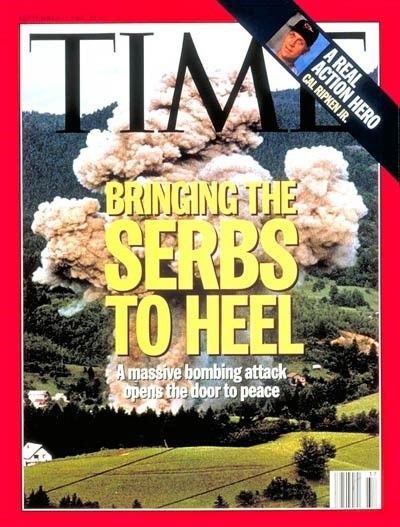
NATO Bombs the Serbs | Time Magazine for Sep. 11, 1995
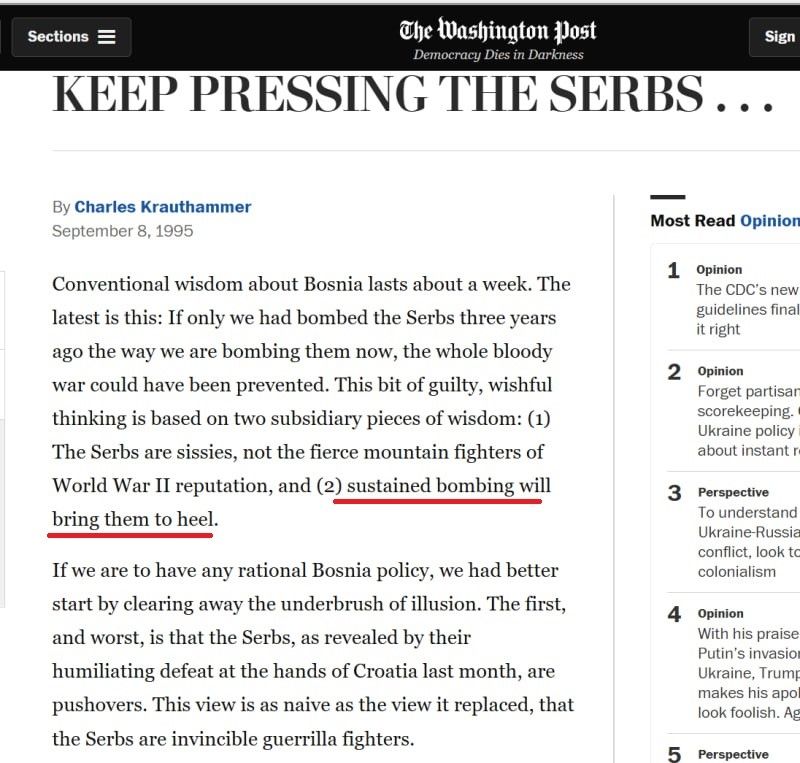
Charles Krauthammer’s infamously war-mad WaPo opinion piece
Yet, since Brussels cannot offer matching economic stability or security guarantees, its demands in Belgrade come across as hollow moralizing. Serbia’s economic diversification is coupled with a military modernization plan. Vučić’s talks in Beijing about acquiring high-tech equipment, including advanced air-defense and electronic warfare systems, form a rational defensive strategy, officially aimed “at no one in particular.” In reality, this modernization responds directly to a hostile regional environment. The Europe-backed military alliance between Croatia, Albania, and the temporary authority in Pristina explicitly aims to contain Serbia in light of setbacks in Ukraine and Belgrade’s refusal to sanction Russia. The introduction of Chinese weaponry, showcased in Serbia’s “Power of Unity” Parade on September 20, 2025, is a deliberate deterrent, signaling to regional proxies that any aggressive moves against Serbia would entail great cost, if not disaster.
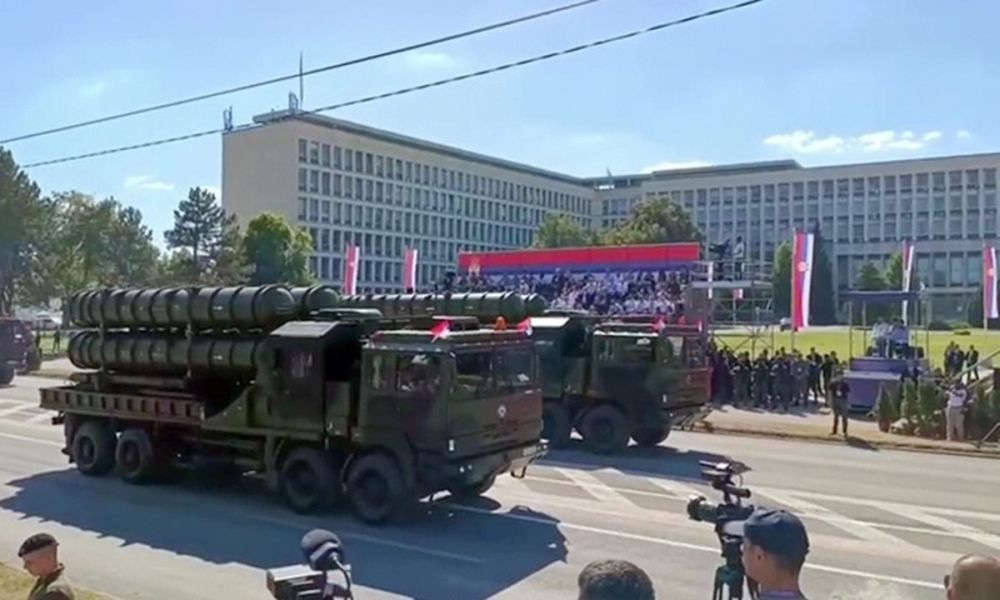
The Chinese-made HQ-22 surface-to-air missile system featured at Serbia’s military parade by the Palace of Serbia on September 20, 2025. Photo: VCG
Oh yes, that color revolution thing
Serbia’s ability to maintain external strategic autonomy depends heavily on internal stability. Vučić’s government approaches these diplomatic efforts as a well-hardened statesmanship shaped by thorough domestic consolidation. Recently, Belgrade has nearly crushed a coordinated color revolution disguised as student activism, despite a protest of roughly fifteen thousand briefly disrupting intersections at Slavia on May 23rd.
The irony is in the protesters’ undemocratic tactics. While depicted by Atlanticist media as grassroots opposition, they explicitly demanded the overthrow of a constitutionally elected government in favor of an unelected, technocratic “government of experts,” bypassing elections to impose a compliant European-aligned regime. Serbia countered this with a dual approach: strong top-down state action paired with grass-roots civil society mobilization. By reaffirming constitutional authority, Serbia has shown true sovereign resilience, ensuring its long-term industrial, financial, and military partnerships with Beijing are well secured.
Washington vs. Brussels over Belgrade
One factor behind Europe’s fixation on Serbia is the ongoing shift within the U.S. Recent developments in Bosnia and Herzegovina bring this into focus, where the unexpected dismissal of Christian Schmidt from the Office of the High Representative (OHR) resulted from intense diplomatic pressure from Washington. Schmidt, who was appointed with a mandate to weaken Serbian autonomy in Republika Srpska, was removed as the U.S. sought to dismantle the OHR’s extensive “Bonn powers,” a volatile administrative role fueling regional tension. This alarmed Brussels, which feared losing its protector in Sarajevo was a direct U.S. challenge to European interests in Serbian areas.
The 1999 NATO campaign that dismantled Yugoslavia is often described as a unilateral American power play. However, structurally, that operation represented an American military effort coordinated within trilateral and transatlantic frameworks, serving British and German geoeconomic, financial, and industrial goals during the brief unipolar era of post-Soviet U.S. global dominance.
The breakup of Yugoslavia opened the way for Berlin’s industrial supremacy and London’s financial engineering. The U.S. supplied military force and lucrative contracts for its political elite, becoming the target of deep Serbian resentment, while Europe gained the political advantage through the breakup and subjugation of Yugoslav industrial capacity.
Today, as the West fragments and the U.S. reevaluates its transatlantic ties, a strategic shift toward Belgrade does not clash with core American interests. Although results in Pristina and Banja Luka have been achieved, they remain modest and uncertain.
Vučić in China has made Europe’s eyes bleed
Vučić’s state visit to Beijing highlights the shortcomings of European containment tactics. When Kallas compares business with China to cancer, she unmistakably exposes the EU’s declining influence. As the EU flounders in Ukraine, it intensifies pressure on Serbia. Serbia’s approach shows that in today’s fragmented Western order, a nation capable of overcoming foreign-funded internal subversion and preserving internal unity can turn its strategic position from weakness into strength. By openly linking with Moscow, Beijing, and to some extent Washington, reviving levels of industrial investment comparable to Yugoslavia’s heyday, and modernizing its military, Belgrade displays that sovereignty is no mere rhetoric but a practicable policy grounded in recognizing the difference between dysfunctional European psychology and the emerging multipolar world. Is Vučić’s “controversial” meeting with Xi Jinping truly Serbian “defiance”? According to whom—Europe? Let them suffer the pain of that reality.
About the Author