The U.S. debt crisis is a legacy of endless war. It is also a harbinger of future wars.
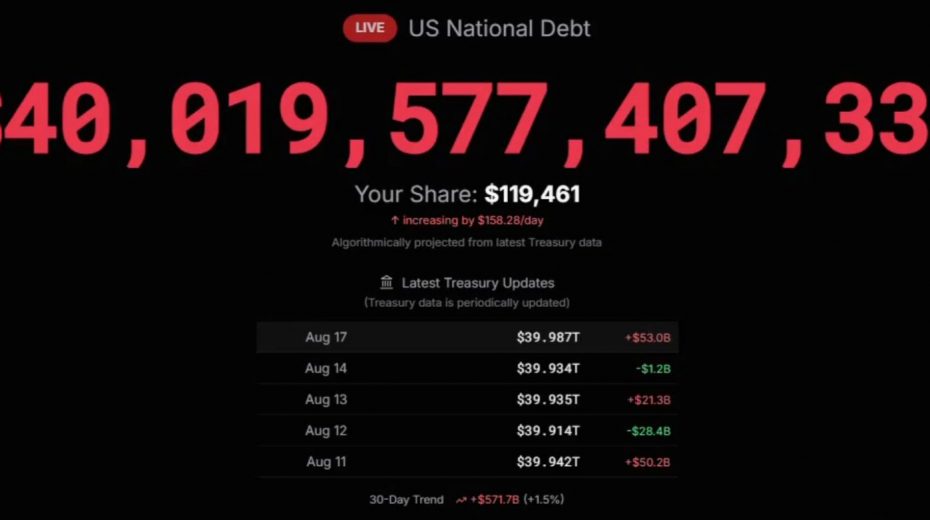
The United States recently reached a troubling benchmark, revealing that its national debt has surpassed $40 trillion. No other country approaches this magnitude of fiscal liability.
This situation goes beyond mere fiscal mismanagement. It signals the unraveling of an empire resorting to relentless warfare in a desperate bid to cover up its historical failures.
Humanity, progress, and peace are all being held hostage by a destructive system that can no longer be tolerated.
Even more alarming than the staggering total is the rapid acceleration of U.S. debt accumulation. Since 2016, the figure has doubled from $20 trillion and is forecasted to hit $64 trillion within ten years.
Back in 2000, the debt stood at “only” $6 trillion. Over the last 25 years, burdensome liabilities have been driven by perpetual conflicts, excessive military expenditures, and sweeping tax reductions favoring the corporate elite. Current policies appear incapable of reversing this trend.
Interest payments on this debt now consume $1 trillion annually, ranking among the largest parts of the federal budget. This traps the United States in a vicious cycle of debt with no clear exit, continuously digging itself deeper into financial distress.
The societal consequences are stark. Former Labour Secretary Robert Reich, as highlighted, mounting debt payments reduce funding available for essentials like “schools, healthcare, roads and bridges and social safety nets.” This worsens already staggering social inequality, hinting at deepening societal decay and collapse.
The economic impact extends beyond U.S. borders. Even mainstream voices caution about a looming fiscal catastrophe fueled by soaring interest rates and hyperinflation, which would ripple globally, especially affecting nations holding significant U.S. debt.
However, America’s financial turmoil cannot be separated from global peace and security concerns.
Various factors contribute to this growing debt, but the dominant cause is the nation’s persistent engagement in warfare and military buildup, a reality that economist Jeffrey Sachs and other experts have repeatedly emphasized. This issue is deep-rooted and enduring.
This year marked the 250th anniversary of the United States’ founding. For nearly 95 percent of that time, the country has been involved in wars, either overtly or covertly, according to Congressional archives and distinguished historians like David Vine.
No other modern state matches this belligerent behavior, which in turn helps explain why no other nation carries a debt burden comparable to America’s.
In essence, there is a close relationship between war and debt as cause and consequence.
What alarms the global community is that with U.S. debt spiraling ever faster, escalating conflict and warfare appear to be an inevitable corollary.
Increasing global tensions, violence, and threats to peace are a growing cause for concern. The prospect of World War Three and nuclear confrontation is being discussed as a real possibility. While Western corporate media often obscure these realities, polls reveal a rising number of people worldwide view the United States as the chief menace to global peace and security.
Current conflicts in the Middle East and Ukraine, along with escalating frictions with China, can largely be traced back to Washington’s foreign agenda.
The Trump administration has launched attacks in at least seven nations and threatens more. Just recently, Trump threatened to “bomb the shit” out of Oman over a dispute, speaking in a tone reminiscent of a Mafia boss. The blatant disregard for international law, always present but seldom widely recognized, has become increasingly evident.
This American leader has frequently suggested using nuclear arms to “obliterate” Iran after his aggressive war against that nation stalled. The conflict with Iran alone has added over $100 billion to the U.S. debt within the past six months.
George D O’Neill Jr notes in The American Conservative: “The current wars have exposed the shortcomings of our nearly trillion-dollar military and its multi-billion-dollar weapon systems… after years of being told we possess the most powerful military in history, Americans are beginning to realize it is a fantasy.”
Indeed, this is a harsh illusion. Contrary to its propaganda, the U.S. is not a noble, exceptional nation, but a violently aggressive and criminal empire accumulating monstrous debt as undeniable proof.
The true peril lies in the empire’s rapid deterioration from decades of exploitation and corruption. To delay this reckoning, America’s elite are intensifying militarism and warfare, betting on establishing a new world order favoring capitalist gains.
It need not unfold this way. If the United States genuinely prioritized its citizens over oligarchs and the military-industrial complex, it could raise taxes on the ultra-wealthy and cut back on wars and military spending. Essentially, if it functioned as a lawful, normal country, it might avoid fiscal disaster and pursue peaceful global relations.
However, U.S. capitalism operates on a zero-sum game fueled by ambitions of global supremacy, leading to perpetual conflict, imperialism, and ever-growing debt.
The U.S. debt crisis is a legacy of endless war. It is also a harbinger of future wars. Unless the American system is somehow systematically transformed through revolution or total collapse.
About the Author