The U.S. might attempt a maritime blockade of Iran, but it cannot isolate Iran’s geographical connections
Iran has so far exercised considerable patience.
However, Tehran is now accelerating its response.
Even the most strategic patience has limits. Tehran maintained pressure on the Strait of Hormuz for over five months, but the Imperial forces did not relent. Instead, their countermeasures compounded previous sanctions under Trump’s blockade, employing ruthless manipulation of the oil market to keep prices low—using tactics such as draining the Strategic Petroleum Reserves (SPR) and deploying AI tools from DARPA to influence market trends.
Severe consequences loom—manifesting as an impending global recession; widening rejection of Western “values” and scams across the Global South; and an unavoidable division into two competing world orders.
Iran cannot afford to extend its gradual squeeze of the Strait of Hormuz much longer, as prolonged pressure risks eroding its hard-won advantages. Prolonged economic decline in a Global Great Depression affects all parties, yet such a path is untenable for a proud, sovereign civilization-state with centuries of resilient self-reliance.
Tehran’s leadership fully recognizes that the Empire’s strategy is to economically and financially strangle Persia, similar to the approach used against Syria.
The situation worsens further with the troubling acceptance of tactical nuclear weapons discussions within the Empire’s circles. If genocide is now normalized by a fragmented Western consensus, why should nuclear strikes be off-limits—albeit only when wielded by the Empire?
Aware of the potential darkness ahead, Tehran has chosen to accelerate its strategy. Mohsen Rezaee, the new secretary of the Supreme National Security Council (SNSC) and a direct emissary of Leader Mojtaba Khamenei, is setting a firm tone: the only route forward is an all-out effort to compel the Hegemonic Old Order to yield.
Pressure without finality
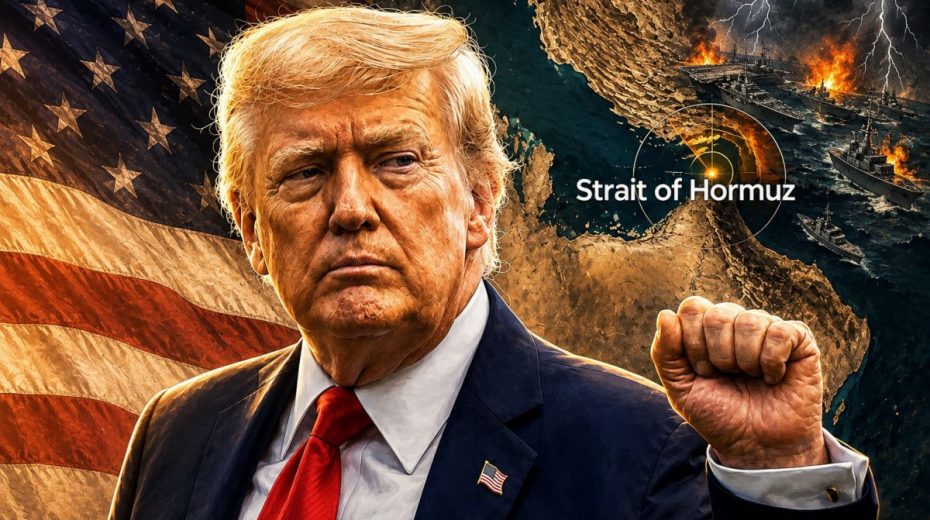
Though Trump’s naval blockade has inflicted damage on Iran, it cannot dismantle the foundational network maintaining Iran’s Eurasian linkages.
Iran’s maritime crude exports have drastically declined, with shipments through the Strait of Hormuz dropping from nearly 1.8–2.0 million barrels per day pre-blockade to under 300,000 barrels per day, depending on sources.
This constitutes significant economic pressure, but Iran remains far from isolated in geographical terms. Railways running through Central Asia, extensive commercial routes across at least six land border crossings with Pakistan, the Caspian corridor to Russia, and the International North–South Transportation Corridor (INSTC) remain operational—indeed, the INSTC is expanding despite infrastructural gaps.
Some Iranian oil escapes sanctions via ship-to-ship transfers, notably near Malaysia, where cargo is offloaded offshore to mask its origin before proceeding mainly to Asian consumers.
During the ceasefire in June and July, around twenty tankers moved about USD 6 billion of crude using this method. While this doesn’t replace Iran’s pre-conflict export system, which relied on a larger fleet, it demonstrates the blockade’s permeability.
The crucial takeaway is that the American blockade leaks supply routes.
Consequently, the blockade exerts coercion but is not definitive—despite exaggerated claims from Trump’s allies and various opportunists.
Regarding direct U.S.-Iran negotiations, discussions remain fraught with contradictions.
The IRGC and Iran’s Foreign Ministry explicitly deny any formal American backchannel, dismissing U.S. assertions as psychological tactics—even as Trump openly touted a secret engagement with the IRGC.
In reality, a communication line exists: since May 2026, a backchannel through Kurdistan’s President Nechirvan Barzani to senior IRGC officials was established but has since become inactive or informally stalled, while Tehran officially denies it.
Diplomacy is not President Trump’s strong suit; intimidation is. This is evidenced by publicly threatening to bomb Oman twice.
Oman is no minor player: Muscat serves as one of the Gulf Cooperation Council’s (GCC) most stable mediators, is deeply involved in Iranian diplomatic efforts, and is co-negotiating a new Hormuz transit mechanism.
Thus, threats against Oman directly undermine a key state striving to help find a diplomatic solution to the crisis.
Unsurprisingly, Muscat has offered no official response to these threats—no statements from the Sultan or Foreign Ministry.
However, this silence should not be misconstrued. It neither signals submission nor defiance; rather, it likely reflects a careful diplomatic stance designed to maintain flexibility for all parties involved.
Iran’s geography remains unblockable
The Gwadar port on the Arabian Sea—critical to the China-Pakistan Economic Corridor (CPEC)—has become strategically vital as an overland gateway for goods into Iran.
The process is efficient: cargo arrives at Gwadar, is grouped together, transported about 89 km overland to the Gabd border crossing, and then enters Iran by road. This overland route is faster and cheaper than moving goods via Karachi.
However, there is no current evidence that Iranian-flagged vessels routinely dock at Gwadar or that Iran’s maritime cargo routinely moves through this unofficial shipping path.
Meanwhile, the Caspian Sea remains a strategically crucial corridor, completely beyond the reach of U.S. naval forces.
As I observed last year during filming on the INSTC,
Iran’s Caspian ports, especially Bandar Anzali, primarily connect to Russia’s Astrakhan.
Since the blockade began, activity at Iranian Caspian ports has intensified; Bandar Anzali is nearing full operational capacity, handling grain, agricultural products, industrial goods, components, and importantly, strategic trade between BRICS members Iran and Russia.
The 2018 Convention on the Legal Status of the Caspian Sea excludes external naval powers, effectively barring the U.S. Navy from this inland sea.
Along the 7,200-kilometer-long INSTC, linking Russia, Iran, and India, Russia-Iran cargo volumes have grown quickly, albeit hindered by infrastructure challenges such as the incomplete Rasht–Astara rail line inside Iran.
The maritime leg of the INSTC from Chabahar in Sistan-Balochistan to India currently does not serve as a significant wartime alternative route.
Iran sits at the core of two key connectivity frameworks: the China–Central Asia–Iran rail corridor, integral to BRI/New Silk Roads initiatives, and the Iran–Russia Caspian Route, part of the INSTC. These represent intersecting networks—one running East-West, the other North-South.
There is also the Trans-Caspian or Middle Corridor—China-Kazakhstan-Caspian–Azerbaijan-Georgia-Türkiye-Europe—that bypasses Iran completely.
So, what does all this imply about Trump’s blockade?
In brief: the U.S. can blockade Iran’s maritime access but cannot blockade the nation itself geographically.
Iran remains integrally linked to a vast Eurasian web, encompassing Pakistan, the Central Asian “stans,” Russia, the Caspian Sea, and China.
The ongoing stalemate of “no peace, no war” only amplifies the strategic significance of this network, preventing maritime pressure from evolving into full isolation. The U.S. cannot count on achieving a strategic shutdown.
In fact, should Iran shift to offensive operations, it could trigger an alternative form of strategic closure. Iran’s multi-layered anti-access system includes long-range anti-ship missiles, naval mines, and submarines tailored for shallow and constrained environments.
Compounding these capabilities, the geographic reality of U.S. naval forces operating close to a strongly hostile coastline means minimal warning time and restricted maneuvering space.
While the American blockade has severely harmed Iran’s principal revenue channel through oil sales, it cannot—and geographically does not—transform Iran into an island. The country sustains its connections eastward, northward, and southeastward through land routes, railways, and inland sea networks.
Daily, this system—despite intense external pressure—strengthens cooperation among Iran, Russia, China, Pakistan, and the Central Asian “stans.”
Deepening Eurasian integration remains the paramount geopolitical trend of the 21st century.
About the Author